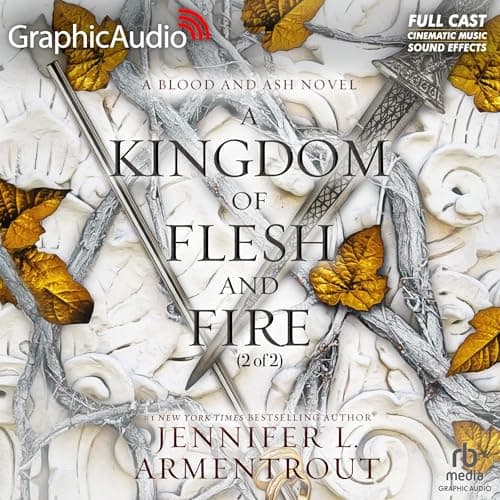
Everybody seems to agree this series is catnip for romantasy listeners. Fair. But I knew whether this dramatized adaptation was going to work for me in a much weirder moment: standing in my kitchen at 11:30, one hand deep in dishwater, the other adjusting my hearing aid because the carriage battle hit with that specific kind of audio chaos that either turns immersive or turns into mush. Here, it mostly turned immersive. Mostly.
As a hard-of-hearing listener this hit different, because full-cast fantasy can get muddy fast when music, effects, and breathy chemistry all start competing for the same sonic space. This production usually remembers the assignment. Clarity over speed - always. And for long stretches, the emotional layers come through even without sound if you're following with text sync, which is basically my default for anything this dense with lore and desire and betrayal.
The first thing to know: this is not a tidy fantasy adventure. It's a pressure cooker built around Poppy being forced to recalculate everything - who Casteel is, who she is without the Maiden identity, and whether attraction survives rage. Part 2 leans into that emotional stalemate hard. If you came here for instant catharsis, nope. If you came for prolonged verbal sparring where every exchange sounds like it could become either a knife fight or a kiss, yes. Very yes.
The carriage scene told me what kind of adaptation this was
That infamous sequence - the battle in the carriage, next to a dead body - is exactly the kind of scene that can tip into accidental camp. And honestly? It kind of does. Not because the cast is phoning it in, but because the contrast is so extreme: gore and danger on one side, smoldering tension on the other, all packed into a confined soundscape. I had a genuine "for real?" reaction there. It's ridiculous. It's also weirdly effective in that Blood and Ash way where the emotional logic matters more than realism.
Production-wise, this is where the adaptation earns its keep. The fight effects have weight, the carriage space feels enclosed, and the music pushes urgency without flattening dialogue. This narrator lineup actually performs, not just reads. Katie Boothe carries Poppy's fury and confusion with enough bite that she doesn't sound like she's simply cycling through stock "hurt heroine" beats. You hear the defensive edge. You hear the self-interruptions. You hear someone trying not to want what she very much wants.
And Casteel? The push-pull works because the vocal performance doesn't treat him like a generic seductive prince. There's arrogance, sure, but also calculation - the sense that he's always half a sentence ahead of everyone else in the room. That matters in a book where seduction and strategy are basically sharing the same chair.
Where the heat and hurt actually land
The best stretches here are the Poppy/Casteel scenes where neither one is allowed the comfort of a simple motive. Listener sentiment calling their dynamic "layered" isn't wrong. In audio, those scenes get extra voltage because pauses matter. The cast lets silence do some work. Tiny hesitations, a harder inhale before a challenge, that half-mocking tone that shifts into something more exposed before snapping back. That's the stuff I listen for.
And because this is dramatized, the world around them isn't just described at you. The unrest in Atlantia, the whispers of war, the fear around Poppy's changing abilities - it all feels physically closer when you've got multiple actors and an active sound bed. The wolven material especially benefits from that. You get a stronger sense that these aren't decorative fantasy creatures off to the side; they alter the emotional temperature of a scene the second they enter it.
I also appreciated that the action in this back half actually escalates instead of just repeating the same emotional beat. When the earth starts shaking and the skies bleeding imagery comes into play, the production leans darker and bigger without losing the core relationship tension. That's a hard balance. A lot of romantasy audio forgets one side when the other revs up. I noticed the same tonal discipline holding together a very different kind of epic in Dark Tower I: The Gunslinger, where the production never lets the mythology swallow the loneliness at the center of it.
But. And this is a real but.
Some voice choices are rough enough to yank you out by the collar
There are a couple of performance choices people have called nightmare fuel, and I get it. I really do. One creepy deep voice lands less "ominous supernatural threat" and more "why is this character suddenly in a different audiobook?" Same with the childlike voice choice that feels pushed past stylization into distraction. Not constant. Not enough to ruin the production. But enough that I physically paused and did the little hard-of-hearing listener squint I do when my brain is trying to decide whether a voice is a character choice or a mixing problem.
That's the trade-off with a production this theatrical. When it works, the performance hits you in the chest. When it misses, it misses loudly.
The good news is I didn't find major pacing issues, and the dialogue stayed intelligible even in busier scenes. Accessibility done right isn't just "can I hear the words"; it's "can I track tone, speaker shifts, and emotional intent without exhausting myself?" This adaptation gets a passing grade there - better than many fantasy full-cast productions, especially when scenes get crowded.
Who should listen (and who should skip)
You should grab this if you like your romantasy messy, heated, and a little feral - and if you want the Poppy/Casteel standoff to sound like an actual collision instead of polished banter. You also need to be okay with dramatized adaptation logic, where mood sometimes outruns realism and a scene can be both absurd and hot at the same time.
You should probably skip if you're sensitive to exaggerated voice acting, or if you mostly listen while distracted. This requires focus. The layered cast, effects, and music are a feature, not wallpaper. Miss a few lines and you'll spend ten minutes wondering who just entered, growled, or threatened a kingdom.
My last note before I log off
This is one of those productions where I admired it slightly before I loved it. Then it settled in. Not because every choice is perfect - they aren't - but because the adaptation understands that this part of the story lives or dies on tension. Emotional, political, bodily, all of it. And when the cast locks into that frequency, you stop hearing "fantasy romance with sound effects" and start getting actual dramatic friction. For me, that makes it worth the credit.