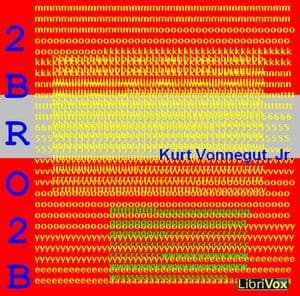

"To be or not to be" — except the phone number is literally 2 B R 0 2 B, and it's the number you call when you volunteer to die so someone else can be born. That's the whole premise, delivered in 22 minutes, and honestly? It hit me harder than some 20-hour epics I've ground through this year.
I listened to this at 11:30 PM on a Tuesday, post-incident-review for a cascading failure in one of our storage services. Kevin was already asleep, I was too wired to close my eyes, and I figured — 22 minutes, classic Vonnegut, free LibriVox recording. What's the worst that could happen?
The Worst That Could Happen Was the Audio
So look. This is a dramatic reading, meaning multiple LibriVox volunteers each recorded a different character. In theory, this is great — you get distinct voices for Mr. Wehling, the painter, Dr. Hitz, the orderly. In practice, it sounds like a Zoom call from 2020 where nobody's mic settings match. One character sounds like they're in a closet. Another has this faint room hum. The transitions between speakers have this jarring cut that yanks you out of the scene every single time.
It's like — imagine a distributed system where every microservice is running a different logging format. Technically they all work. But debugging the interaction between them? Pain. Pure pain. That's this recording.
One listener said they've "had better experiences in elementary school read aloud sessions," and while that's savage, I can't fully disagree. There's zero sense of characters actually being in the same room together, which is a problem when the entire story takes place in a hospital waiting room with escalating tension between a desperate father and a cheerful government doctor.
But the Story — the Story Is a Scalpel
Here's where I have to separate the delivery vehicle from the payload. Vonnegut wrote this in 1962 and it's basically a Black Mirror episode before Black Mirror existed. Shift runs with that same suffocating premise — a society so optimized for control that the cost of being human gets buried somewhere in the fine print. Population is locked. Aging is cured. Want to have a baby? Someone has to volunteer to die first. Mr. Wehling's wife is having triplets, and he needs three volunteers. Three people have to call 2 B R 0 2 B — the Federal Bureau of Termination — and schedule their deaths so his kids can exist.
The hospital scenes are suffocating even at 22 minutes. Dr. Hitz is this casually monstrous figure who treats population management like it's a scheduling optimization problem (honestly, I've met PMs like this). The painter working on a mural in the waiting room serves as this quiet moral witness. And Wehling — the way he breaks under the weight of what society is asking him to accept — that scene lands even through the patchy audio.
Vonnegut doesn't waste a single sentence. There's no worldbuilding bloat, no exposition dumps. He drops you in, makes you uncomfortable, and gets out. The ROI on this audiobook is insane — 22 minutes for a story that'll rattle around in your head for days.
Who Gets the Kill Switch
If you're a Vonnegut fan and you've somehow missed this short story, grab it. It's free. Just set your expectations for the production accordingly.
If you're new to Vonnegut — honestly, read the text version on Project Gutenberg instead. It's like 2,000 words. The LibriVox dramatic reading adds friction that a first-timer doesn't need.
If you're an audiobook snob (and I say this with love, because I am one) — the production quality will genuinely bother you. The ambient noise mismatch between characters is the kind of thing you can't unhear once you notice it. It's like listening to a podcast where one host recorded in their car and the other in a studio.
But if you're like me — lying in bed at midnight, brain still buzzing from a production incident, wanting something short and sharp that doesn't require 15 hours of commitment? This does the job.
TL;DR, Ship It
Perfect for: insomnia, waiting rooms, that weird 20-minute gap between meetings. Skip for: anyone who needs polished production to stay engaged. The story is vintage Vonnegut operating at maximum efficiency — a 22-minute thought experiment about what happens when society optimizes for longevity and accidentally optimizes away the value of being alive. The LibriVox production is the weakest link by a mile, but for free? I've paid actual money for worse.