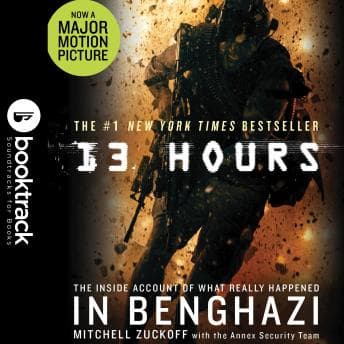

"Stand down." That's the order these guys kept hearing while Americans were under attack. Around hour three of this audiobook, when Zuckoff lays out the timeline of the team waiting - ready, armed, watching the compound burn on camera feeds - and being told to wait, I had to pause. Not because it was confusing. Because I was furious. And I was standing in my kitchen at 10 PM making kimchi jjigae that I completely forgot about until the pot boiled over.
Bottom line: This is an 8-hour audiobook that earns almost every one of those hours. That's rare. I say "almost" because the Booktrack music thing is... a choice we need to talk about.
When the Author Is the Narrator and It Actually Works
Mitchell Zuckoff narrates his own book, and here's the thing - he's a journalism professor at BU, not a voice actor, and you can tell. His delivery is clear, his diction is precise, but there's a flatness to it that some listeners will bounce off of. I get it. He doesn't have the gravelly military thriller voice you might expect from a book about a firefight in Libya.
But here's why it works for me: Zuckoff sounds like a reporter reading back his notes. Matter-of-fact. Measured. When he describes Tyrone Woods and the team moving through mortar fire toward the Annex, there's no dramatic vocal escalation - it's just the facts laid bare, and somehow that restraint makes it hit harder. The camaraderie between the operators comes through in how Zuckoff handles their dialogue, their callsigns, their dark humor about the bureaucratic absurdity happening above their heads while they're getting shot at.
This is what my parents did instinctively - just showed up and did the work without theatrics. Now it has a TED talk. Or in this case, an 8-hour audiobook.
The Booktrack Edition adds a musical score underneath the narration. Gentle ambient stuff, some tension-building strings during the combat sequences. Conceptually, fine. In practice, about 60% effective. During the quiet setup chapters - the geography of Benghazi, the diplomatic context - the music adds atmosphere without distraction. During the actual attack sequences, it occasionally steps on moments that would've been more powerful in silence. A mortar hits. Men are screaming. I don't need violins telling me how to feel about that. The silence between explosions IS the soundtrack.
The 45-Minute Meeting That Should've Been an Email (But Wasn't)
I typically complain that business and nonfiction books pad their runtime. This one doesn't, mostly. Zuckoff front-loads context about the political situation in Libya, the CIA's presence, the State Department's security posture (or lack of it) - and all of it pays off later. When you understand how thinly staffed that compound was, how the security requests were denied or ignored, the attack itself becomes not just tragic but infuriating in a very specific, systemic way.
I've seen this kind of organizational failure at companies - not life-or-death, obviously, but the same pattern. Leadership ignoring field-level intelligence. Risk assessments filed and forgotten. The people closest to the problem screaming into the void while decision-makers three levels up optimize for optics. Zuckoff doesn't editorialize much - he's disciplined enough to let the timeline speak for itself. The 13-hour structure (real-time, hour by hour) forces you to sit with the slowness of the bureaucratic response while the operational tempo on the ground is absolute chaos.
The comparison to the Michael Bay movie starring John Krasinski is worth noting. The film is solid action. The audiobook is the version that makes you angry at systems, not just bad guys. You get interior monologues, the operators' backgrounds, their families back home. Oz, Rone, Tanto, Tig, D.B., Jack - they're not just action figures. They're guys who took contractor jobs because the pay was better than government work, who missed their kids' birthdays, who calculated risk for a living and knew the math wasn't adding up that night.
Who Gets the Invoice
If you're into military history, this is essential listening. If you followed the Benghazi story through cable news - regardless of which channel - this will recalibrate your understanding. Zuckoff strips away the political theater and gives you ground truth. That same appetite for ground truth over mythology is what drew me to Under the Black Flag - different era, same discipline of letting documented reality dismantle the comfortable story we'd rather believe.
Skip this if you need a dynamic narrator to stay engaged. Zuckoff is competent, not captivating. And if the Booktrack music concept sounds gimmicky to you, it kind of is - though it's unobtrusive enough that I stopped noticing it by hour five.
The key takeaway is worth the listen. For once, the other 7 hours are too. Jenny would say I'm being generous. For once, Jenny is wrong.






![Steve Jobs [unabridged audiobook] audiobook cover](/_next/image?url=https%3A%2F%2Fcovers.audiobooks.com%2Fimages%2Fcovers%2Ffull%2F9788499923406.jpg&w=1920&q=75)