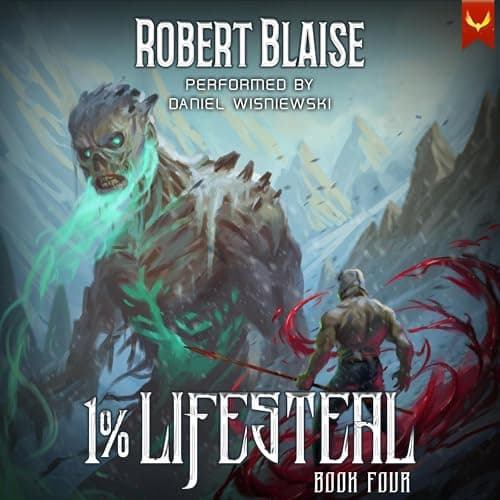

Most people talk about LitRPG like it's all power scaling and stat screens. And sure, that's part of the appeal - I get it. But I was shelving returns at the library on a slow Wednesday evening, earbuds in, Volume 4 playing, and I realized I'd stopped moving entirely. Just standing there in the 600s section holding a book about mushroom foraging, completely locked into Freddy trying to hold Repentawa together against a monster horde he has no business surviving. That's not stat-screen energy. That's dread.
And look, I don't come to LitRPG for dread. That's what Shirley Jackson is for. But Robert Blaise has been quietly building something across four volumes that borrows more from survival horror than most progression fantasy authors would ever attempt. Freddy's lifesteal mechanic - stealing 1% of power from everything he kills - sounds broken on paper. In practice, it means every fight is a calculation. Every encounter is a risk-reward gamble where the math might not math. Volume 4 leans into this harder than the previous books, throwing Freddy into city management AND a monster apocalypse simultaneously, and the tension works because Blaise never lets you forget how thin the margins are.
When the Horde Hits, the Stakes Actually Land
The monster frenzy across the Northern Belt is the centerpiece here, and it's structured like a slow-building disaster movie. Blaise doesn't just throw wave after wave at you - he seeds the political complications first. Freddy has a city deed but basically no institutional support, and the mainland factions circling Repentawa feel less like allies and more like vultures waiting for him to fail. When the horde finally crashes in, you've already internalized how many ways this can go wrong. That's good horror structure applied to fantasy, and I'm here for it. Last Man Standing works a similar angle — survival mechanics wrapped around genuine stakes, where the tension comes from scarcity and bad odds rather than spectacle.
What surprised me is how much emotional weight Blaise puts on Freddy's determination to do right by people. This isn't a power fantasy where the MC stomps everything in sight. Freddy's "weak-to-strong" trajectory means he's constantly outmatched, constantly improvising, and the book doesn't shy away from the cost of that. There's genuine psychological pressure here - the kind Blaise apparently built his reputation on over at Royal Road, and it shows.
Wisniewski Commits (Mostly)
Daniel Wisniewski's narration is a polarizing topic in this series, and I want to be straight about where I land. His Freddy is excellent - there's a rawness to how he voices the MC's internal struggle that elevates the emotional beats. When Freddy's backed into a corner politically or physically, Wisniewski sells the desperation without going melodramatic. The pacing is tight across nearly eighteen hours, which is no small thing.
But. The character voices are inconsistent. Some land perfectly - you can hear the faction differences, the class tensions between characters. Others feel like they wandered in from a different audiobook. The controversial accent work from Volume 3 (that "tropey fake Canadian" voice for a gay character that listeners rightfully called out) still lingers as a trust issue. I didn't catch anything that egregious in Volume 4, but I was listening for it, and that wariness itself is a problem. When a narrator makes you brace instead of relax, some of the magic leaks out.
The narrator commits, though. That's rare in this genre, where a lot of LitRPG narration defaults to flat "reading aloud" energy. Wisniewski is acting, and even when a choice doesn't land, you can feel the effort. I'd rather have a narrator who swings big and occasionally misses than one who plays it safe for eighteen hours.
Who Should Listen (And Who Should Skip)
If you've been following the series, this is a no-brainer - Volume 4 pays off threads from all three previous books and the escalation feels earned rather than manufactured. If you're new? Don't start here. Go back to Volume 1. The power system and political landscape need the buildup. And if you need your LitRPG clean and crunchy - pure stats, no existential weight - this probably isn't your thing. Blaise is playing a different game.
For the progression fantasy crowd who keep telling me horror and LitRPG don't mix - this understands that horror isn't about gore, it's about dread. The dread of responsibility, of inadequacy, of a horde bearing down on people who are counting on you. Blaise gets that. Freddy's lifesteal mechanic is just the vehicle.
My podcast listeners are going to love this. Seventeen hours and fifty-five minutes is a commitment, but I burned through it in four days, which for me during a work week means something clicked hard. Shirley (my cat) was unimpressed. I was not.