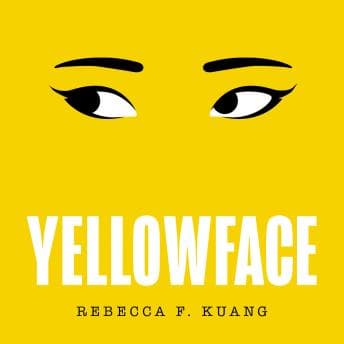

June Hayward is the worst person I've ever spent eight and a half hours with. And I teach high school. I know worst people.
I finished Yellowface at 1 AM on a Wednesday, sitting at the kitchen table with a stack of ungraded sophomore essays and a cup of coffee that had gone cold two hours ago. Denise had already gone to bed. The essays could wait. June Hayward had me by the throat, and I couldn't look away from the wreck she was making of her life.
The Unreliable Narrator We Deserve
Let's talk about what Rebecca F. Kuang is really doing here, because on the surface this looks like a publishing satire — and it is — but underneath it's something much nastier. June steals a dead woman's manuscript. Athena Liu, her more talented, more successful, more everything rival, chokes to death at a dinner party, and June walks out with an unpublished novel about Chinese laborers in World War I. Then she revises it. Publishes it under a ambiguous pen name. Becomes famous.
And here's the thing that kept me up past midnight: Kuang writes June's self-justification so convincingly that you catch yourself nodding along. "Well, she did revise it substantially." "Athena wasn't using those stories from her own lived experience anyway — she grew up in Connecticut." June's internal logic is airtight right up until you step back and realize you've been slowly poisoned. This reminds me of what Hemingway said about the iceberg — what's underneath is doing all the work. Except here, what's underneath is complicity. Yours.
My students would hate this. I love it. They'd hate it because June isn't likable, and they still think protagonists should be. I love it because Kuang trusts her reader enough to hand them a narrator who lies to herself on every single page and lets you figure out which lies you're buying.
Helen Laser and the Art of Performing Delusion
Helen Laser gets something crucial about this performance: June needs to sound reasonable. Not villainous, not cartoonishly evil. Reasonable. Laser pitches her voice in this register of perpetual wounded righteousness — like a colleague who got passed over for department chair and wants you to know they're fine with it. They're so fine. (They're not fine.)
Where Laser really earns it is in the Twitter spiral sections. And yes, there are Twitter spiral sections — Kuang basically transcribes the experience of watching your mentions turn hostile in real time, and Laser's pacing gets faster, clipped, almost breathless as June doom-scrolls through accusations of cultural appropriation. The narrator understands that pause is punctuation, and she uses silence in the early chapters — those quiet beats after June makes a decision she knows is wrong — like a held breath before a car crash.
That said, she hits a few flat stretches in the middle act. When June starts dealing with her editor and publicist, the corporate publishing-speak scenes don't quite land with the same energy. Laser's tone goes a bit monotone during what should be tense negotiation scenes, like she's reading the business parts of a thriller rather than living in them. It's not a dealbreaker, but I noticed.
The Book Publishing Wants You to Read (and Also Doesn't)
Here's what makes Yellowface genuinely uncomfortable rather than just clever: Kuang works in publishing. She is publishing's golden child — Yale, Cambridge, a bestselling fantasy trilogy before she turned 25. And she wrote a book that basically says the industry uses diversity as a marketing category while being structurally hostile to the people it claims to champion. June's publisher doesn't care that the manuscript might be stolen. They care about the optics of the situation changing.
The prose deserves to be savored, but not in the way I usually mean that. It's not lyrical. It's sharp and clean and slightly toxic, like drinking from a polished glass that might be rimmed with something wrong. Kuang writes in this deliberately flat, confessional style — June's voice — that mirrors how people actually talk themselves into terrible things. No grand speeches. Just one small rationalization after another.
At 8 hours 39 minutes, it's tight. No bloat. This is a book that knows exactly how long it needs to be and doesn't waste your time. Worth pausing the faculty meeting for. (Sorry, Principal Martinez. Again.)
Who This Is Actually For
If you loved Patricia Highsmith's Ripley novels — that sick thrill of watching someone maintain a lie through sheer audacity — this is their spiritual successor, transplanted into the world of book publishing and online outrage culture. If you're in any creative field where questions of ownership and authenticity come up, this will crawl under your skin.
Skip it if you need someone to root for. There's nobody here. That's the point. I had a similar nobody-to-root-for experience with Crossroads, though Franzen at least gives you characters who are trying to be good — they're just catastrophically bad at it.
If you're a writer, this might hurt. In a way you probably need.
The Red Pen Says
I've been teaching long enough to know when a young writer is showing off versus when they have something to say. Kuang has something to say. And she's angry enough — and disciplined enough — to say it through a character you'll despise while making you wonder how many of June's rationalizations you share. That's not satire. That's surgery.
I'm going to go grade those essays now. They'll feel simple after this.