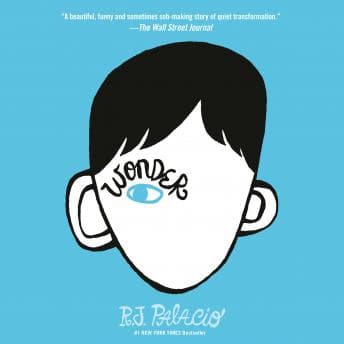

So here's the thing: I picked this up because Kevin's niece is turning 10 and he asked me to vet it before gifting the audiobook. I figured I'd listen to the first hour during my morning commute and call it done. Instead I finished the whole thing in a single round trip plus my lunch break, and then I sat in my car in the Mountain View parking garage for six minutes because Auggie's graduation scene hit me somewhere I wasn't prepared for.
I'm a 30-year-old software engineer. This is a middle-grade novel about a 5th grader with a craniofacial condition starting public school. And it wrecked me on a Tuesday.
Six Narrators for One Kid's World
TL;DR: Worth your commute, even if you don't have a kid in your life.
The audiobook uses six narrators - Santino Barnard as Auggie, plus Dariana Alvarez, Kaya McLean, Lila Sage Bromley, Madeleine Curry, and Ry Chase rotating through the other POV characters. This is basically microservices architecture but for storytelling - each narrator owns their character's perspective completely, and the handoffs between them are clean. You always know exactly whose head you're in.
Santino Barnard as Auggie is the standout. He sounds like an actual kid, not an adult performing kid-ness, which is harder to pull off than people think. There's this matter-of-fact quality to how he delivers Auggie's self-deprecating humor about his face - "Whatever you're thinking, it's probably worse" - that lands because it's not played for sympathy. It's just... how this kid talks. The way he reads the lunch scenes, where Auggie is hyper-aware of who's willing to sit near him, has this quiet tension that's almost unbearable.
The sister Via's narrator (I believe Lila Sage Bromley) carries a different weight - this low-key resentment mixed with fierce protectiveness that's so specific to being a sibling of someone who requires enormous parental bandwidth. When the perspective shifts to Via, the whole emotional frequency changes. You go from Auggie's "please just let me be normal" energy to Via's "I know I'm supposed to be okay but I'm not always okay" energy, and the narrator transition makes that shift physical, not just textual.
The Structure Is the Point
Palacio does something clever with the rotating POV structure that I didn't appreciate until about hour 3. You experience Auggie's first day at Beecher Prep from his perspective - the staring, the empty seats around him, the one kid (Jack Will) who actually talks to him like a human. And it's painful but contained. Then later you get Jack Will's perspective on that same period, and you realize how much Auggie missed - the social calculus happening around him, the peer pressure not to befriend him, the moment Jack makes his choice. It's the same data viewed from different monitoring dashboards, and the composite picture is way richer than any single view.
At 7 hours 10 minutes, it's tight. No bloat. Every perspective shift earns its place. The boyfriend character (Justin, Via's boyfriend) gets maybe 45 minutes of POV time and Palacio uses it to show how Auggie's situation ripples outward into people who've never even met him. That's efficient storytelling.
The Julian sections - Julian being the primary bully - are the hardest to listen to. Not because they're graphic, but because Palacio writes kid cruelty with surgical accuracy. The whisper campaigns, the "choose sides" dynamics, the way adults are always three steps behind. I had flashbacks to middle school that I thought I'd fully suppressed, thanks.
Who This Is Actually For
Here's my honest take: yes, it's a kids' book. The prose is simple. The moral arc is not exactly ambiguous - kindness good, bullying bad, you will cry. If you need moral complexity and grimdark worldbuilding, this is not your book.
But.
The emotional engineering here is precise. Palacio knows exactly when to shift perspectives to maximize impact, and the multi-narrator format turns that structural choice into something you feel in your chest. I listen to hard sci-fi and business books about distributed systems. This book about a 10-year-old walking into a cafeteria made me more anxious than most thrillers. The only other audiobook that's pulled off that kind of quiet, unexpected gut-punch for me was Elves and the Shoemaker — completely different stakes, but that same deceptive simplicity hiding something that gets under your skin.
Perfect for: train, roadtrip with kids, or honestly just a day when you need to believe people can be decent. Skip for: if you're allergic to sentimentality or need something you can zone out during. This one requires just enough attention that 6AM zombie mode might cost you some emotional beats.
Speed note: I did my usual 1.5x and it worked fine, but the kid narrators are already naturally paced - pushing past 1.5x might make them sound artificially sped up in a way that breaks the illusion.
The ROI on Seven Hours of Feelings
The ROI on this audiobook is weird to quantify because it's not teaching you anything actionable. It's not optimizing your morning routine or explaining quantum computing. It just made me text Kevin's niece a voice message telling her she's awesome, and then I sat through a standup meeting feeling oddly gentle toward my coworkers. So maybe the ROI is becoming 5% less of a robot? I'll take it.
I finished this in 2 commutes. I'm buying the audiobook for Kevin's niece and honestly probably re-listening to it next time on-call rotation makes me hate humanity.