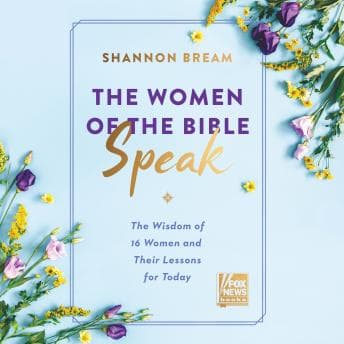

My parents went to a Korean Presbyterian church every Sunday for thirty years. My mom knew every woman in the Bible by name, in Korean, and could tell you their stories while pressing shirts. She didn't need Shannon Bream's book. But I did.
I started this one on a Sunday morning - Jenny was at brunch with friends, I was doing meal prep for the week, and I figured a 6.5-hour faith-based listen would pair well with dicing onions. It did. More than I expected.
Sixteen Women, Eight Pairs, One Actually Smart Framework
Here's what separates this from the usual devotional fare: Bream pairs the women. Sarah with Hagar. Ruth with Naomi. Esther with Rahab. Hannah with Miriam. Each pair shares thematic DNA but made wildly different choices under pressure. It's basically a case study format - and as someone who spent eight years at McKinsey building frameworks, I respect the structural discipline here. You're not just getting sixteen mini-biographies dumped in sequence. You're getting a comparative analysis that forces you to think about why two women in similar circumstances ended up in completely different places.
The Esther-Rahab pairing stuck with me. Both outsiders. Both operating inside hostile power structures. Both making life-or-death decisions with incomplete information. Bream draws the contrast between Esther's calculated patience - waiting for the right banquet, the right moment to reveal Haman's plot - and Rahab's snap decision to hide the spies. Different risk profiles, same courage. That's not Sunday school fluff. That's strategic thinking under existential threat. My parents would've recognized both approaches. You do what the situation demands.
The Author-Narrator Question
Shannon Bream reads her own book, and look - she's a news anchor, not a voice actor. You can hear the difference. There's a broadcast quality to her delivery that's polished and warm but occasionally lands a bit too even, too measured, when the material calls for raw emotion. When she's reflecting on Hannah's grief over her barrenness, or Mary Magdalene's moment at the empty tomb, you want the voice to crack a little. It doesn't quite get there.
But here's the thing - and this is where author-narrated books sometimes win - you can hear when Bream genuinely cares about a passage versus when she's bridging to the next section. There are these small moments where she drops in personal asides, almost like she's talking to a friend over coffee rather than recording in a studio. Those moments are the best parts of the listen. The quips are light, the reflections feel earned rather than performed.
At 2.0x she sounds like a slightly caffeinated morning show host, which honestly works fine. I'd recommend 1.25x if you're actually using this devotionally. Let the pairings breathe.
What My Mom Already Knew
This is what my parents did instinctively. Now it has a TED talk. My mom understood that the women in the Bible weren't supporting characters - they were the infrastructure. The ones holding families together during exile, famine, political upheaval. Bream makes this case for a mainstream audience, and she does it without being preachy or academic. It's accessible without being shallow.
The weak spots? Some pairings work better than others. The Mary and Martha section covers ground that's been tread so many times I could practically recite it from childhood sermons. And there are stretches where Bream summarizes Biblical narrative that anyone with basic Scripture knowledge already has - fine for newcomers, but at 2.0x I was reaching for the 30-second skip.
Also - and Jenny would say I'm being harsh, Jenny is right - the modern application sections can feel a bit surface-level. "How does Esther's courage apply to YOUR life?" is a question that deserves a harder answer than what we get. I wanted more of the comparative framework and less of the inspirational conclusion paragraphs. The analysis is strong. The takeaways sometimes read like a church bulletin. I ran into the same ceiling with Leader In Me — solid structural thinking that occasionally collapses into inspirational poster territory right when you want it to push harder.
Who Gets the ROI Here
If you grew up in the church and think you know these stories cold, the pairing structure will genuinely give you a new lens. That's the value proposition. If you're new to Biblical women, this is probably the most approachable entry point on Audible right now - 6.5 hours, clean structure, warm narrator. If you want deep theological scholarship, this isn't that. It's not trying to be.
Women's Bible study groups will get the most mileage - each pair is basically a ready-made discussion session.
Bottom Line on the Ledger
Bottom line: Shannon Bream built a smarter framework than most business books I've reviewed this year. Pair, compare, extract the principle, apply. At 6.5 hours it respects your time, which is more than I can say for 70% of my Audible library. The narration is good-not-great, the structure is the star, and somewhere my mom is nodding because she knew all of this forty years ago without a #1 bestseller to tell her.









