
I was reorganizing my bookshelves on a rainy Saturday afternoon when I put this on, figuring a nine-and-a-half-hour listen would carry me through the task and maybe into the evening. What I didn't expect was to still be sitting on the floor three hours later, surrounded by unsorted paperbacks, completely absorbed in Tom Hazard's centuries-long struggle to connect with anyone.
Bottom Line: A warm, gently philosophical audiobook about immortality and loneliness, lifted by Christoph Maria Herbst's dry, melancholic narration. Not Haig's strongest work, but a genuinely enjoyable listen that'll make you think about what you'd do with too much time. Solid 3.5-to-4-star territory.
Matt Haig's premise is deceptively simple: a man who ages roughly fifteen times slower than normal humans has lived through four centuries of history, and the emotional cost has been devastating. Tom has walked the streets of Elizabethan London, sailed with Captain Cook, and drifted through 1920s Paris — and every few decades, he sheds his identity like a snake sheds skin. The catch? He belongs to a shadowy organization called the Albatross Society, and their cardinal rule is never to form attachments. Never fall in love. The novel alternates between Tom's present-day life as a history teacher in East London and vivid flashbacks to his past lives, and the structure works surprisingly well as an audiobook because each time period has its own emotional register.
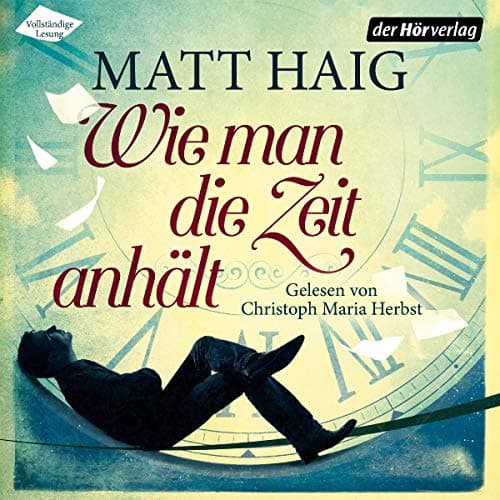
Christoph Maria Herbst narrates the German edition, and his casting here is genuinely inspired. His voice has a dry, slightly melancholic quality that mirrors Tom's weary wit perfectly. When Tom cracks a joke about having literally lived through a historical period his students are studying, Herbst delivers it with the kind of understated deadpan that makes you smile rather than laugh out loud — exactly the tone Haig intended. His pacing is brisk but never rushed; you can follow every sentence without rewinding, though you might want to slow down occasionally just to sit with certain passages.
Where Herbst falls slightly short is in differentiating supporting characters. His female voices don't vary much, and when multiple characters share a scene, you sometimes need a beat to register who's speaking. It's not a dealbreaker — this is fundamentally Tom's internal story, and the first-person narration means we're in his head ninety percent of the time — but if you're coming from one of Herbst's children's audiobook performances where he goes wild with character voices, you'll notice the restraint. A few passages also have slightly unusual delivery choices that momentarily pulled me out of the story, though I couldn't point to a pattern.
The book itself is classic Haig: warm, accessible, gently philosophical. He's interested in big questions — what gives life meaning when you have too much of it, whether love is worth the inevitable loss, how memory shapes identity — but he never lets the ideas overwhelm the story. Tom is a sympathetic protagonist, lonely in a way that feels earned rather than performative, and when Camille, his colleague and a single mother, enters his orbit, you root for him even though you know the rules he's supposed to follow.
If you've read Haig's "The Midnight Library," you'll notice this one doesn't reach the same emotional depth. The historical vignettes are entertaining but sometimes feel more like scenic postcards than fully realized worlds. The plot, particularly its thriller elements involving the Albatross Society, is serviceable rather than surprising. I hit that same mild frustration with Dire Straits, where the bones of a compelling thriller kept getting in their own way. And Tom's character arc, while satisfying, follows a path you can see coming from about the halfway mark. None of this makes it a bad book — it's genuinely enjoyable and often moving — but it sits a tier below Haig's best work.
At just under ten hours, it's a comfortable listen that doesn't overstay its welcome. The pacing suits focused listening — this isn't one to throw on while doing something cognitively demanding, because the jumps between time periods require your attention — but it's also gentle enough for a long evening walk or a quiet commute. I ended up finishing it the same weekend I started, which says something about its pull.
Herbst's narration elevates what could have been a straightforward read into something with real atmosphere. His voice carries the weight of Tom's centuries without ever becoming ponderous, and the emotional moments — particularly around Tom's lost love and his search for his daughter — land with genuine feeling. It's not a showy performance, but it's the right one for this material.
Who Should Listen (And Who Should Skip)
German-language audiobook listeners who want something that blends historical fiction, light sci-fi, and an emotional core about what it means to be human — this is a solid pick. If you need a tightly plotted thriller or distinct character voices from your narrator, look elsewhere. It won't change your life, but it might make you think differently about the one you have.