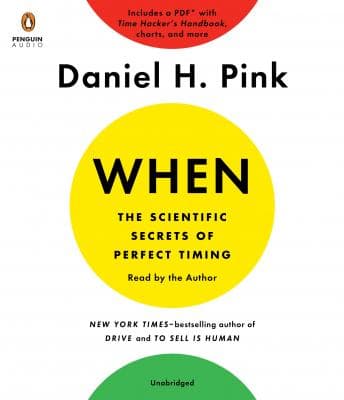

Daniel Pink just made me feel personally attacked about my 2 PM coffee habit.
I started this during my morning commute—which, according to Pink, is actually the optimal time for analytical thinking. So I was accidentally doing science while stuck on the Red Line. The irony wasn't lost on me.
Why Author-Narrators Usually Make Me Nervous
Look, I've suffered through enough author-read audiobooks to know the pattern: brilliant writer, terrible narrator. They mumble. They rush. They sound like they're reading their grocery list. So when I saw Pink was narrating his own work, I braced myself.
I was wrong. Really wrong.
Pink brings this infectious energy that most professional narrators would kill for. He's polished but not slick, if that makes sense. There's enthusiasm without the used-car-salesman vibe. The man genuinely seems excited about chronobiology, and somehow that excitement becomes contagious. By chapter three, I was genuinely invested in the research about when hospitals have higher mortality rates. (Spoiler: don't schedule surgery in the afternoon. You're welcome.)
The pacing is tight—five hours and change, which is perfect for a book like this. No padding, no repetitive summaries of what you just heard. Pink trusts you to keep up.
The Stuff That'll Actually Change Your Tuesday
Here's where I have to be honest with my fellow educators. Some of the research Pink cites about school start times? I've been saying this for twenty years. Teenagers aren't lazy—their circadian rhythms are literally shifted later. Pink backs this up with actual data, not just the frustrated observations of someone who's watched seventeen-year-olds fall asleep during Hamlet.
The book is structured around three big ideas: beginnings, midpoints, and endings. And the research is genuinely surprising. Midpoints, for instance—they can either be a slump or a spark. Pink shows how the awareness of being halfway through something can actually motivate action. (I tested this theory during my last grading marathon. Jury's still out.)
But here's my one complaint, and it's not small: the title promises "secrets" and "perfect timing," which sets expectations for a how-to manual. This isn't that. It's more like—here's a bunch of fascinating research about when humans perform best, now figure out how to apply it yourself. Some listeners will find that frustrating. I found it refreshing, honestly. Pink treats you like an adult who can synthesize information.
The Classroom Connection (Because I Can't Help Myself)
I kept pausing to jot down notes for my students. The section on restorative breaks? That's going into my syllabus. The research on how afternoon test scores drop? I'm bringing that to the next faculty meeting. (Sorry, Martinez, I'm going to be that guy.)
Pink's writing style reminds me of what Malcolm Gladwell does well—taking academic research and making it accessible without dumbing it down. That same skill with weaving narrative into structure shows up in Wuthering Heights, though obviously with more Yorkshire moors and fewer chronobiology studies. He threads in stories about Danish students, bank robbers, and Barcelona's La Sagrada Familia in ways that actually illuminate the science rather than just decorating it.
My wife Denise listened to parts of this with me during our weekend lakefront walks. She's a nurse, and the hospital timing stuff genuinely concerned her. "I knew this," she kept saying. "We all know this. Why doesn't administration know this?" Good question.
Who This Works For (And Who It Won't)
If you want a rigid productivity system with exact times to do exact things, this will frustrate you. Pink isn't prescriptive in that way. He's more interested in helping you understand the why behind timing so you can make better decisions. Skip it if you need step-by-step instructions. But if you're someone who reads nonfiction to understand the world a little better—to have that "huh, I never thought about it that way" moment—this delivers. Multiple times.
I finished it during a late-night grading session. Which, according to Pink's research, is basically the worst time for me to be evaluating student essays. But some of us don't have the luxury of optimal timing. We just have papers due tomorrow and a podcast episode to record this weekend.
At least now I know why I'm so irritable at 3 PM. That's worth something.