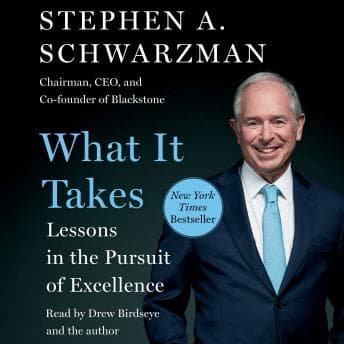

"Be relentless. Be excellent. Be worth remembering."
That line hit me somewhere around hour 3, crammed into a window seat on the 6:47 AM Caltrain, and I actually paused the book to think about it. Which is rare for me with business books—usually I'm speeding through them at 1.75x trying to extract the three useful insights buried under 200 pages of padding.
This one's different. Mostly.
The Schwarzman Operating System
Bottom Line: Worth your commute. This is basically a crash course in "how to think like a billionaire" but for people who actually want the tactical playbook, not just the inspirational fluff.
Stephen Schwarzman built Blackstone from $400k to managing over $500 billion. That's not a typo. And unlike most CEO memoirs that read like extended LinkedIn posts, he actually breaks down the decision-making frameworks that got him there. His "25 Rules for Work and Life" scattered throughout—things like "Don't lose money. Ever." and "Every deal has a thousand details"—sound obvious until you realize how rarely people actually execute on them.
The ROI on this audiobook is solid if you're in any kind of deal-making, fundraising, or leadership role. He walks through specific negotiations—the Hilton acquisition, the failed attempt to buy Hershey (yes, the chocolate company), his early career failures at Lehman Brothers. Real numbers, real stakes, real lessons.
Drew Birdseye Does the Heavy Lifting
Here's where I have to be honest: Schwarzman himself narrates portions of this book, and... look, the man is a financial genius, not a voice actor. His sections are fine—authentic, clearly personal—but Drew Birdseye carries the bulk of the 11-hour runtime, and thank god for that.
Birdseye has this clean, professional delivery that matches the content perfectly. No dramatic flourishes, no weird pauses. Just clear storytelling that lets the material breathe. For a business book, that's exactly what you want. I didn't have to rewind once, even during the more technical sections about private equity structures.
Perfect for: train, gym. Skip for: bedtime (unless you want to dream about leveraged buyouts).
Where It Drags (Because It Does)
I finished this in about 5 commutes, which means I had plenty of time to notice the padding. The philanthropy sections—his work with MIT, Oxford, Tsinghua University—feel like they belong in a different book. Important? Sure. But they slow the momentum considerably around hour 7-8.
And some of the name-dropping gets exhausting. Yes, Steve, you know every world leader. Yes, you've advised multiple presidents. We get it. The constant parade of powerful friends starts to feel less like context and more like a flex.
Could've been a tighter 7-8 hours, honestly. But that's true of basically every business book ever written.
The Actually Useful Bits
What kept me listening was the specificity. When he talks about hiring, he doesn't just say "hire great people"—he explains his 10-point interview system and why he looks for people who've overcome significant obstacles. When he discusses deal-making, he breaks down the exact moment he realized a negotiation was going sideways and how he pivoted. If you're looking for the interpersonal side of those pivots—reading the room, building rapport when stakes are high—Networking for People covers that ground without the billion-dollar price tags.
His framework for identifying opportunities—looking for "big, transformational ideas" rather than incremental improvements—is basically how I think about debugging production systems. That same focus on root causes over surface fixes shows up in QBQ! The Question Behind the Question, though with less private equity and more personal accountability. Find the root cause, not the symptom. Solve the problem at scale, not the instance.
(My boyfriend Kevin pointed out I was taking notes during our weekend hike. In my defense, Schwarzman's thoughts on building culture were genuinely useful for the team lead role I'm eyeing.)
Who Gets Value Here (And Who Doesn't)
This is for: founders, aspiring executives, anyone in finance or PE, people who want to understand how the ultra-wealthy actually think about risk and opportunity. Also surprisingly useful if you're just trying to level up your negotiation skills.
Skip if: you want a quick read, you're allergic to wealth, or you're looking for work-life balance advice. Schwarzman's philosophy is basically "be excellent or go home," and if that sounds exhausting to you, this isn't your book.
My Caltrain Verdict
At 1.5x speed, this got me through a particularly brutal on-call week. The stories are engaging enough to follow while half-asleep, the lessons are concrete enough to actually remember, and Birdseye's narration is professional without being boring.
It's not Ray Porter (need I say more?), but it's solid. Worth a credit if you're in business or leadership. Wait for a sale if you're just casually interested in billionaire memoirs.
The science of deal-making actually holds up here. That's more than I can say for most books in this genre.