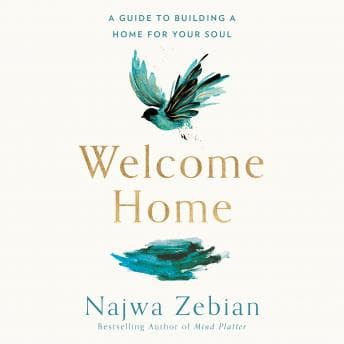

I was up at 2 AM redesigning a brand identity for a yoga studio—ironic timing, I know—when I hit play on this one. Frida was curled on my chest like she was trying to physically hold me together, and Diego was doing that judgmental loaf thing on the corner of my desk. Something about the quiet of my apartment, the glow of my monitor, and Najwa Zebian's voice coming through my headphones made me feel like I'd accidentally walked into the most tender therapy session of my life.
She Talks to You Like Your Abuela at the Kitchen Table
Here's what got me: Najwa narrates her own book, and her Lebanese-Canadian accent gives every word this specific warmth that doesn't sound rehearsed. It sounds like someone sitting across from you, holding your hands, and telling you the hard truths while making you chamomile tea. There's a softness to how she lands on words like "belonging" and "surrender" that I physically felt in my sternum. She's not performing. She's confessing. And there's a massive difference.
The book is structured around building rooms in a metaphorical house—self-love, forgiveness, compassion, clarity, surrender, and a dream garden—and each section includes her own stories of rejection, of feeling homeless inside herself. When she talks about seeking validation from people who had no intention of giving it, about placing her self-worth in someone else's hands like handing them a grenade? That hit. I paused the audio, stared at my ceiling, and had to breathe for a minute because my abuela used to say something similar in her own way. "No le des las llaves de tu casa a quien no te quiere adentro." Don't give the keys to your house to someone who doesn't want you inside.
Abuela would have nodded through every chapter of this one, and at the final one she would have said "te lo dije" — right before reminding me she'd been saying it my whole life.
The Rooms Where I Stayed Too Long
The forgiveness room wrecked me. Not because Najwa says anything revolutionary about forgiveness—honestly, some of the advice IS things you've heard before, dressed up in a new metaphor—but because of HOW she says it. She weaves her poetry into the narrative sections, and there's one piece about releasing someone from the story you wrote for them that made me ugly-cry at chapter... I don't even know, I lost track. It was somewhere around hour five and I was supposed to be picking hex codes for this yoga studio project but instead I was crying into a cold cup of coffee while Frida purred aggressively on my lap.
The guided exercises and journaling prompts are threaded through each room, and I'll be honest—I skipped most of them. Not because they're bad but because I was listening, not reading, and stopping to journal would've broken the spell of her voice. I think this book might actually be better in print if you want to DO the work. But as an audiobook, as a listening experience? It's a slow evening with candles and blankets and permission to feel messy.
Sometimes I want the opposite from an audiobook—Tim Curry turning Series of Unfortunate Events #12: The Penultimate Peril into a gleeful one-man show you can't help but get swept up in.Here's where I'll push back, though: the pacing is slow. Like, genuinely slow. At nearly ten hours, some rooms felt like they had too many windows and not enough furniture—the clarity section in particular kept circling the same ideas, and I caught my attention drifting to my design work a few times. And yes, some of the advice lands as simplistic if you've already done therapy or read Brené Brown or, you know, survived being a first-gen kid navigating two cultures at once. We've been building our own houses since birth, Najwa. Some of us just didn't have a blueprint.
But simplicity isn't always a weakness. Sometimes the obvious thing said by the right person at the right time can crack you open.
Who Gets the Keys
If you're someone who's in the thick of it—freshly heartbroken, freshly grieving, freshly lost—this book will feel like someone turned a light on in a room you've been sitting in for too long. If you're further along in your healing and want hard tactical strategies, you might find it too gentle. That's okay. Not every book is for every season.
When I craved something with more grit and actual homework, Badass Habits handed me the boundaries and daily upgrades I could actually implement.If you're a fast-paced, give-me-the-bullet-points person, this will test your patience. But if you're like me—savoring at 1.0x, letting someone's voice wash over you while your hands do the work of creating—this is exactly the right speed.
The Room I'm Still Sitting In
I finished this book three days ago and I keep thinking about the surrender room. About how Najwa frames lowering your defenses not as weakness but as the bravest architecture. My heart. MY HEART. I'm not going to pretend this book changed my life—that feels dishonest—but it did make me softer toward myself at 2 AM on a Tuesday, and honestly? That's enough.