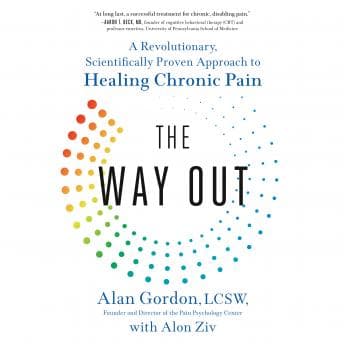

I need to rant about the title for a second. "A Revolutionary, Scientifically Proven Approach to Healing Chronic Pain." Every word in that subtitle is doing the absolute most. Revolutionary? Scientifically proven? Healing? It's like someone fed a late-night infomercial into a subtitle generator. My BS detector went to DEFCON 1 before I even hit play.
And then Alan Gordon had to go and be... pretty convincing.
Your Brain Is Lying to You (And That's Actually Good News)
I was in my home office at 11 PM, prepping a deck for a Series B startup that's hemorrhaging cash, when I figured I'd throw this on. Nearly five hours, which for a self-help book is actually respectful of your time. The core thesis: most chronic pain isn't caused by structural damage in your body. It's your brain misfiring - generating pain signals when there's nothing physically wrong. Gordon calls these "neuroplastic" pain pathways, and Pain Reprocessing Therapy (PRT) is his system for rewiring them.
Here's what caught me: Gordon doesn't just wave his hands and say "it's all in your head." He cites a randomized controlled trial from CU-Boulder where 66% of PRT participants were pain-free or nearly pain-free by the end of the study, compared to the placebo group. Now - some listeners have pushed back on the statistical claims, and I get it. One study, even a good one, isn't the same as "scientifically proven" in the way that subtitle implies. But Gordon's honest enough to walk you through the methodology, which is more than most self-help authors bother with.
The framework itself breaks down into manageable steps. Notice the fear around the pain. Reappraise the danger signals. Gradually teach your brain that the pain isn't actually a threat. It's simple - deceptively so. This is the kind of thing my umma would've heard and said, "So... stop worrying about it?" And she wouldn't be entirely wrong. But Gordon gives you the neuroscience scaffolding to understand why that works, which makes the technique stick. The same pattern shows up in Healing the Shame That Binds You — another book that works precisely because it doesn't just tell you to feel differently, it hands you the underlying wiring diagram for why you feel the way you do.
A Therapist in Your Earbuds
Gordon narrates his own book, and this is one of those rare cases where author-as-narrator is the right call. He's got this calm, unhurried delivery - like a therapist who genuinely wants you to feel okay, not like a motivational speaker trying to sell you a $2,000 workshop. There's humor in here too, the self-deprecating kind. He talks about his own chronic pain journey without martyring himself, which is harder than it sounds in this genre.
Multiple listeners have said it feels like being in an actual therapy session. I can see that. His voice has a soothing quality that works especially well when he's walking you through the reprocessing techniques. You could argue it's a little too relaxed - I bumped it to 1.5x (not my usual 2.0x, because you actually need to absorb the technique portions) and it held up fine.
Where it dragged for me: the patient case studies. Gordon cycles through several examples of people who used PRT to eliminate their pain, and after the third one, the pattern is predictable. Person suffers for years. Doctors find nothing. PRT works. Cue emotional music that isn't actually playing but you can feel Gordon's voice reaching for it. The stories serve their purpose - social proof, hope, etc. - but if you're listening for the framework, chapters 3 through 7 are where the real ROI lives.
What My Parents Knew, What They Didn't
My dad had back pain for twenty years. Stood over a pressing machine six days a week, came home smelling like steam and chemicals, never once considered that his pain might be neuroplastic. And honestly? For him, it probably wasn't - that was real structural wear. This is where Gordon's book needs a bigger disclaimer. He's careful to say PRT isn't for everyone, that structural damage is real, but the title and marketing scream "cure-all" in a way the actual content doesn't support.
For the right audience though - the person who's been to five specialists, gotten three different diagnoses, tried PT and injections and still hurts - this book could genuinely change things. It's not magic. It's a structured approach to retraining your nervous system, backed by at least one solid clinical trial, delivered by a guy who clearly knows his stuff and isn't trying to upsell you.
At 4 hours and 50 minutes, it respects your time. The science is accessible without being dumbed down. The techniques are practical and immediately usable.
The Consulting Memo
Bottom line: If you've got unexplained chronic pain and you've exhausted the medical route, this is worth your five hours. If you're a skeptic, listen anyway - Gordon's framework for understanding pain neuroscience is valuable even if you don't buy the full program. Skip the repetitive case studies in the middle third if you're impatient. The key takeaway is worth the listen. The other 7 hours? Well, there aren't 7 other hours, which is honestly the best compliment I can give a self-help audiobook.
Jenny would say I'm being harsh about the subtitle. Jenny is right. The book is better than its marketing.