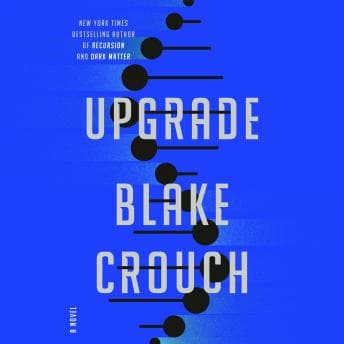

Everyone kept telling me Upgrade was Crouch's weakest book. "It's no Dark Matter," they said. "Recursion was better," they insisted. So I went in with appropriately lowered expectations, which might be why I ended up enjoying this way more than I expected.
Look, I was supposed to be working on my thesis. Dr. Patel sent me three increasingly passive-aggressive emails about my "timeline concerns." But instead of writing about procedural generation algorithms, I was lying on my couch at 2 AM, completely hooked on a story about a guy whose brain gets hacked into superhuman territory. Priorities, right?
The Magic System Is Chef's Kiss
Here's the thing about Crouch that Sanderson fans will appreciate—the man understands that good sci-fi needs rules. Logan's upgrade isn't just "now you're smart." It's specific. He starts reading faster. Then memorizing better. Then needing less sleep. The progression is satisfying in that LitRPG way where you're watching the stats tick upward, except instead of a blue screen overlay, it's described through Logan's increasingly alien perception of the world around him. Project Hail Mary does something similar with its protagonist's problem-solving evolution, though Weir leans harder into the science-as-superpower angle.
The moments where Logan's enhanced cognition kicks in during combat? That's the good stuff. He's calculating trajectories, processing multiple threats simultaneously, seeing patterns normal humans miss. It's like if your D&D wizard suddenly got a permanent Haste spell but also became a strategic genius. My D&D group would love this—we've spent entire sessions debating exactly this kind of "what if you could optimize a human" scenario.
But—and this is where the "not as good as Dark Matter" crowd has a point—there are stretches where the technical writing overwhelms the narrative. Crouch occasionally gets so deep into the genetics that you can feel the plot momentum stalling. It's not quite an info-dump (and honestly, if you don't like info-dumps, this isn't for you, but you're wrong), but it's close.
Henry Levya: Solid But Not Steven Pacey
Let me be real about the narration because the reviews are all over the place on this one. Some people called it mediocre. Others said Levya killed it. Having listened to the whole thing, I land somewhere in the middle.
Levya's strength is Logan's internal turmoil. When Logan's grappling with what he's becoming, questioning whether he's still human, Levya sells it. You feel the existential dread. The quieter moments of Logan processing his enhanced perception—those land.
Where it gets shakier is the female character voices. They're not bad, exactly, but they're not distinct enough. Logan's sister Kira is supposed to be this brilliant, driven, morally complex antagonist, and sometimes her dialogue just... blends into the general narration. For a book that hinges on the sibling relationship, that's a problem.
Action scenes are hit or miss. Some of them kept my heart rate up. Others I found myself zoning out during, which shouldn't happen when enhanced humans are trying to kill each other. Steven Pacey walked so other narrators could run, and Levya's running but occasionally stumbling.
When Your Family Legacy Is "Oops, We Caused a Famine"
The family drama here is genuinely compelling. Logan's mother was a geneticist whose experiment went catastrophically wrong—we're talking global famine, millions dead. Logan grew up in the shadow of that guilt, became a government agent hunting illegal genetic modifications, and now he's been upgraded against his will by... well, that's the mystery.
This is Sanderson-level world-building in terms of how the consequences ripple outward. Every piece of the backstory matters. The genetic upgrade isn't random—it's connected to Logan's mother's research, to his sister's obsession with "fixing" humanity, to the fundamental question of whether we should engineer our own evolution even if we could.
Crouch doesn't give easy answers, which I appreciate. Logan spends the book fighting against a plan that would forcibly upgrade all of humanity, but you can see the argument for it. That moral ambiguity reminds me of the ethical dilemmas in Project Hail Mary, where survival calculations force impossible choices. Climate change, resource depletion, human stupidity—maybe we do need to become something other than ourselves to survive. The book lets you sit with that discomfort.
Who's Rolling Initiative on This One?
Listen if: You're into hard sci-fi with actual rules, you've ever min-maxed a character build, or you want a thriller that asks uncomfortable questions about human enhancement. Fans of Crouch's other work or Weir's science-forward storytelling will find plenty to chew on.
Skip if: You need distinct character voices in your audiobooks, or technical genetics talk makes your eyes glaze over. Also maybe skip if you're behind on your thesis. (Do as I say, not as I do.)
Final Save vs. Thesis Deadline
At just under 10 hours, Upgrade doesn't overstay its welcome. The pacing is mostly tight, though the middle section does this weird thing where it simultaneously feels too short and too dragged out. Like Crouch rushed through some developments but lingered too long on others.
If you've read Dark Matter or Recursion, this is more like Wayward Pines in style—less mind-bending, more thriller-paced. The high concept is there, but it's wrapped in a more conventional action framework. That's not necessarily worse, just different.
I finished it instead of writing my thesis. I regret nothing. (I will regret it when Dr. Patel asks for my draft next week, but that's Future Tom's problem.)
The narration won't blow you away, but it gets the job done. The science is fascinating if you're into genetics. The moral questions linger. And the progression from "slightly sharper" to "functionally superhuman" scratches an itch I didn't know I had.
Not Crouch's best. But still pretty damn good.