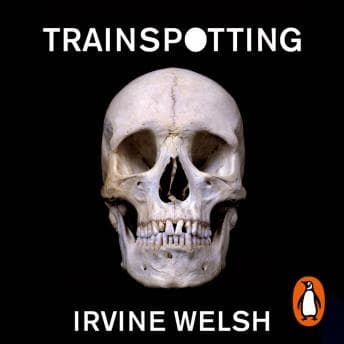

Everyone tells you to watch the film. Danny Boyle, Ewan McGregor, that iconic monologue about choosing life - sure, fine, great movie. But here's the thing nobody warns you about: the book is a fundamentally different animal, and hearing it performed in Scots dialect by Tam Dean Burn at midnight while you're pretending to grade sophomore essays on The Great Gatsby will rearrange something in your brain. I'm still not sure it's been put back right.
The Language Isn't a Barrier - It's the Whole Point
Let me confess something. I tried to read Trainspotting in print about fifteen years ago and bounced off it hard. The phonetic spelling - "cannae," "dinnae," "radge" - it sat on the page like a code I couldn't crack fast enough to stay in the story. And I teach literature for a living. I've waded through Faulkner's unpunctuated stream of consciousness, Joyce's invented vocabulary, Cormac McCarthy's hostility toward quotation marks. But Welsh's Leith dialect on the page defeated me.
The audiobook solves this completely. Tam Dean Burn doesn't translate the Scots into something palatable for non-Scottish ears - he inhabits it. The words that looked impenetrable in print become instantly clear when spoken in their native accent. "Ah didnae ken" stops being a puzzle and becomes a person talking. This is what I mean when I tell my students that literature was oral tradition long before it was print. Welsh wrote these voices to be heard, and Burn proves it.
Tam Dean Burn and the Art of Solo Ensemble
Now, I know there's a multi-narrator version out there, and some folks swear by it. I get the appeal - Renton, Sick Boy, Begbie, Spud, they're all so distinct that casting different voices makes logical sense. But Burn's solo performance does something the ensemble can't: it keeps the whole world inside one consciousness, one community, one shared misery and dark humor that binds these characters together even as heroin tears them apart.
His Begbie is genuinely frightening - there's a coiled violence in the way Burn drops the pitch and tightens the vowels that made me stop grading and just stare at my kitchen wall. His Spud is all loose, shambling warmth, the kind of guy you'd want to protect even as he's making catastrophically bad decisions. And Renton - Burn plays him with this exhausted intelligence, a man smart enough to see the trap and too deep in it to climb out. After a couple of hours, you stop hearing a narrator doing voices and start hearing people you unfortunately know.
Burn lets the silences between Welsh's brutal vignettes do real work. The transitions between chapters - which are really more like interconnected short stories than a traditional novel - hit harder because Burn doesn't rush to fill the quiet.
What Welsh Is Really Saying (And Why It Still Matters)
Let's talk about what the author is really saying, because Trainspotting gets reduced to "Scottish heroin book" the way 1984 gets reduced to "Big Brother surveillance book" - technically accurate, completely insufficient.
Welsh wrote a book about what happens when an entire class of people gets told there's nothing for them. The economics of despair as a structural condition - not a personal failing - is something Last Romantics also wrestles with, though in a quieter, more domestic register that somehow made Welsh's fury hit even harder by contrast when I came back to it. The drugs aren't the point. The drugs are the logical response to the pointlessness. Renton's famous "choose life" monologue isn't nihilism - it's a precise, furious inventory of everything consumer society offers as a substitute for meaning. I teach kids on the South Side of Chicago who've never touched heroin and have never been to Edinburgh, and they'd recognize every single emotion in this book. The geography changes. The economics of despair don't.
It already feels like a classic - a 1993 novel that captured something about late capitalism's relationship to addiction and class that hasn't aged a day.
Would I ever assign it? Absolutely not - I'd be clearing out my desk by Monday. (Though my juniors would probably devour it, so let's keep that between us.)
Who This Is For (And Who Should Run)
If you need a linear plot with a redemption arc and a character who learns a valuable lesson, this will make you miserable. Welsh structures the book as fractured vignettes - different narrators, different timelines, stories that loop back on themselves. It demands focused listening. This is not a background-while-doing-dishes audiobook.
But if you loved A Clockwork Orange and its invented slang, if you've ever been fascinated by how dialect carries identity, if you want fiction that's simultaneously hilarious and devastating - this is its spiritual successor, or maybe its rougher, meaner Scottish cousin.
Content warning: everything. Violence, sexual content, addiction depicted with zero romanticism, a scene involving a dead baby that is exactly as awful as that sounds. Welsh doesn't flinch, and Burn doesn't let you flinch either.
Worth the Ungraded Essays
Twelve hours. That's what this asks of you. Twelve hours of thick Scots dialect, fractured narrative, characters you'll love and despise sometimes in the same sentence. Tam Dean Burn's performance is the skeleton key to a book that defeated me in print. I finished it at 1 AM on a Tuesday, essays still ungraded, and immediately texted Denise - who was asleep upstairs - a quote I can't repeat here.
Strip the dialect and Welsh is writing nothing but one true sentences - hundreds of them. They're just in a language you might need Tam Dean Burn to translate.