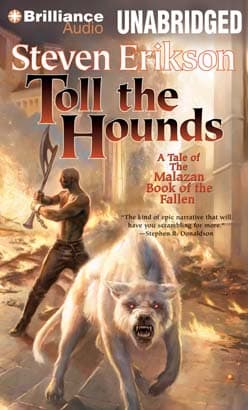
I was shelving returns in the quiet hours before closing — just me, the hum of fluorescent lights, and the last dregs of a cold coffee — when I hit the final stretch of Toll the Hounds. Forty-four hours. That's not a book. That's a relationship. And like most long relationships, this one tested me, rewarded me, and left me staring at nothing for a solid ten minutes after it ended.
Erikson doesn't write fantasy. He writes mythology that happens to be set in a fantasy world. And Toll the Hounds might be where that distinction matters most.
Kruppe's Voice Is Narrating and Nobody Asked Him To
Let's talk about the elephant — or rather, the rotund, waistcoat-wearing man — in the room. Michael Page reads certain chapters in Kruppe's theatrical, third-person voice. If you've been with the Malazan series this long, you know Kruppe: the verbose, self-referential trickster who refers to himself by name and treats every sentence like a stage performance. Page commits to this framing device with his whole chest, and honestly? It works about 70% of the time. When it clicks, it gives Toll the Hounds this oral-storytelling quality, like you're hearing a tale told around a dying fire. When it doesn't click, you're wondering why a chapter about war and grief is being filtered through a character who sounds like he's auditioning for a one-man Shakespeare show.
And then there's the voice issue that's been following Page through the series: Duiker sounds like he's lost his mind. Not in a tragic, broken-by-war way — which would actually fit — but in an "insane old man muttering at pigeons" way that undercuts the gravity of what he's saying. Some characters randomly pick up an Indian accent that wasn't there three books ago. Anomander Rake — the Son of Darkness, the guy carrying Dragnipur, arguably one of the most important figures in the entire Malazan cosmology — doesn't quite land vocally. His voice feels too light for the weight he carries. Page gives you emotional range, genuine feeling in the big moments, but the inconsistency means you're occasionally yanked out of a devastating scene by a voice that doesn't match the character you've spent thousands of pages with.
Here's the thing though: Page has genuinely improved. Compare his work here to the earlier Malazan audiobooks and the leap is real. The emotional peaks hit harder now. He understands the rhythm of Erikson's prose better — the way sentences build and collapse, the way silence matters between revelations. The narrator commits. That's rare. He just also commits to some choices that made me wince.
Forty-Four Hours of Dread Disguised as Fantasy
This understands that horror isn't about gore — it's about dread. And yes, I'm claiming Toll the Hounds as partially horror. Fight me.
Erikson builds this book on a slow, suffocating sense that something terrible is converging. Darujhistan in summer heat. Black Coral under Rake's rule. Ancient crimes waking up. The Hounds. It's a book where assassins hunt and are hunted, where gods move pieces no one can see, and where the emotional payoff at the end feels earned precisely because you spent thirty-something hours watching these threads tighten. The pacing will test you. There are stretches — long stretches — where you're following characters through philosophical rumination and interpersonal grief that feels disconnected from any plot. And then Erikson pulls the threads together and you realize every single one of those quiet, aching chapters was load-bearing.
But I won't pretend the pacing doesn't drag. Around hours fifteen through twenty-five, I caught myself drifting. This isn't a book you put on while doing dishes. This demands your full, undivided brain. I tried listening during a weekend hike once and had to rewind twenty minutes because I'd absorbed nothing. Erikson punishes inattention.
Who Gets the Key to This Particular Gate
If you're already eight books into Malazan, you don't need my permission. You're committed. You know what you're getting into. But if you're wondering whether the audiobook format serves this particular entry — yes, with caveats. Page's emotional delivery during the convergence is genuinely affecting. The mispronunciation of "Soletaken" (still not fixed, somehow, eight books in) is a small but persistent irritation. And the sheer length means you need to be the kind of listener who can maintain focus across weeks of dedicated sessions.
Shirley Jackson walked so Erikson could run — not in style, but in the way both writers understand that the scariest thing isn't the monster arriving. It's knowing it's coming and being unable to stop it. That particular flavor of dread — the slow, inevitable kind — is something I also found gnawing at me through Court of Wings and Ruin, though Maas gets there through emotional devastation rather than mythological weight.
My podcast listeners are going to love arguing about this one. The Kruppe narration choice alone will split the room.
Shelve Under: Worth the Commitment, Despite the Bruises
Forty-four hours. Inconsistent voices. Pacing that requires patience bordering on faith. And yet — when this book hits, it hits like nothing else in the genre. Erikson asks more of his readers than almost any living fantasy author, and Toll the Hounds might be where he asks the most. Page isn't a perfect vessel for it, but he's a dedicated one, and dedication counts for a lot when you're narrating mythology.