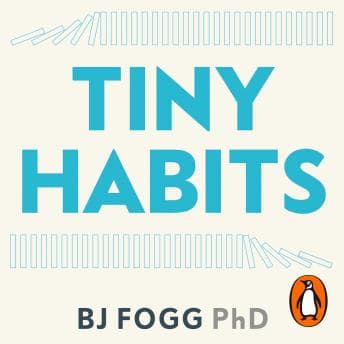

Look, I've listened to approximately 47 self-help audiobooks that promised to change my life. Most of them could've been blog posts. (Okay, maybe aggressive blog posts with nice graphics.) So when I started Tiny Habits during my 6AM Caltrain zombie shuffle, I was already mentally drafting the "skip this" review.
I was wrong. And I'm kind of annoyed about it.
The System That Actually Compiles
Here's what BJ Fogg gets that most productivity gurus don't: willpower is a terrible API. You can't just call it whenever you want and expect reliable results. His whole framework is basically dependency injection for behavior—you anchor new habits to existing routines (he calls them "anchors") and make the new behavior so tiny it's almost embarrassing. Like, "do two pushups after I pee" tiny.
The ROI on this audiobook is genuinely high because the method is immediately implementable. I started three tiny habits before I even finished the book. One of them—flossing one tooth after brushing—has somehow turned into flossing all my teeth. Every. Single. Day. I've tried to build this habit for literally a decade. Fogg would say that's the point: start so small that motivation becomes irrelevant, then let the behavior naturally expand.
The science actually holds up, which matters to me. Twenty years of research at Stanford, 40,000+ people coached through this method. He's not just vibing—there's a behavioral model (B=MAP: Behavior happens when Motivation, Ability, and Prompt converge) that he explains clearly enough that I found myself applying it to debug why my meditation habit kept failing. Turns out I'd been making it too hard and anchoring it to the wrong prompt. Classic user error.
BJ Fogg Narrating BJ Fogg
Okay, so. The narration situation. Fogg reads his own book, and he acknowledges upfront that his voice is high-pitched. (I appreciate the self-awareness.) Here's the thing—it's not a Ray Porter performance. It's not going to win any Audie awards for dramatic range. But it's warm, it's authentic, and honestly? It works for this content.
He sounds like a really enthusiastic professor who genuinely believes you can change your life with tiny adjustments. There's humor in the delivery—little self-deprecating moments, genuine excitement when he talks about success stories. After a few chapters, I stopped noticing the pitch and just... listened. At 1.5x speed (my standard for business-adjacent books), it flows well.
The downside: it can feel a bit long at 11+ hours. Some sections get repetitive—he really wants you to understand the celebration piece (you're supposed to feel a tiny burst of "Shine" after completing a habit), and he hammers it. I found myself zoning out during the third example of someone successfully building a gratitude habit. But honestly, the repetition probably helps the concepts stick.
The PDF Problem (Ugh)
Here's my one real complaint: this audiobook really wants you to download the companion PDF. There are worksheets, diagrams, the whole behavior model visualized. If you're a pure audio listener—which, hello, that's the point of audiobooks—you'll miss some utility. I ended up downloading it and looking at the diagrams during a particularly boring standup, which worked, but it's friction I didn't love.
That said, the core concepts are absolutely followable without the PDF. I understood the framework just fine from audio. The worksheets are bonus, not required.
Queue It If You Want to Actually Start (Skip If You Want a Story)
This isn't a page-turner. You're not going to be gripped by narrative tension. It's a practical manual for behavior change, and it's a good one. I finished it in about 5 commutes, implemented the method, and have seen actual results.
If you're the kind of person who's read Atomic Habits and thought "okay but HOW do I actually start"—this is basically the prequel. For a different angle on making time for what matters, How to Live on Twenty-Four Hours a Day hits some surprisingly similar notes about starting small with your available hours. Fogg was James Clear's teacher, and Tiny Habits is more granular, more focused on the starting problem. Less philosophy, more debugging your actual behavior.
Would I listen again? Probably not cover-to-cover. But I've already gone back to specific chapters when I wanted to troubleshoot a habit that wasn't sticking. That's... actually pretty high praise for a self-help book. Most of them I forget within a week.
Ship It
The method works. The audiobook delivers it clearly. Fogg's enthusiasm is genuine if not electrifying. For a book about making things tiny and easy, it does exactly what it promises.