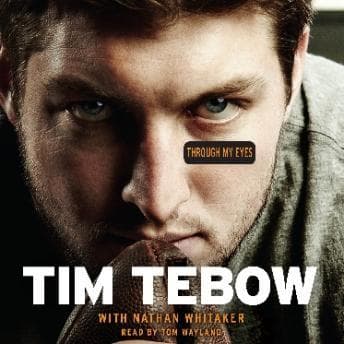

I'll be honest with you: I picked this up expecting to roll my eyes. Tim Tebow is the kind of figure who makes cynics sharpen their knives. The kneeling. The Bible verses on the eye black. The whole spectacle of public faith in a sport that treats Sunday as sacred for entirely different reasons. I'm a literature teacher who spent a semester on Flannery O'Connor's grotesque Southern Christianity - I have opinions about performative belief. So I was not the target audience. And yet. Here I am.
I finished most of this on a Saturday morning walk along the lakefront with Denise, which felt accidentally appropriate - open sky, the kind of light that makes you think about things bigger than your to-do list. The book has that energy. Whatever you think of Tebow the brand, Tebow the person on the page is genuinely disarming.
The Man Behind the Eye Black
What actually surprised me here is the specificity. This isn't a ghostwritten celebrity memoir that skims the surface of a Famous Life. The sections about growing up in the Philippines as a missionary kid - his parents' work, the circumstances of his own birth, the medical crisis his mother faced during pregnancy - these read like someone who actually wants you to understand where he came from, not just what he accomplished. There's a passage about his father's ministry work that contextualizes the whole Tebow phenomenon in a way the sports media never bothered to. When you understand that this kid grew up watching his parents build schools and orphanages in rural Philippines, the public prayer stops looking like a PR move.
The football chapters are competent but not exceptional - if you're here for X's and O's breakdowns of the Florida Gator offense, this isn't that book. What Tebow does well is connect the football to the formation of character, which is a very specific kind of sports memoir. Less Ball Four, more Quiet Strength (which makes sense, given that Nathan Whitaker also co-wrote that Tony Dungy book). My students would hate this. I found it oddly compelling.
The faith content is constant and unapologetic. If that's going to be a dealbreaker for you, know that going in. This isn't a book that brackets the Christianity for secular audiences. Biblical references aren't decorative - they're structural. For readers who share that framework, it probably hits differently. I had a similar experience reading Boundaries in Dating - faith-rooted framework, unapologetically so, and somehow still legible to an outsider like me. For readers who don't, it's still a coherent worldview, consistently applied. I can respect that even when I'm not in the congregation.
Where the Audio Version Stumbles
This is where I have to be direct, because the narration genuinely costs this audiobook something.
Tom Wayland has a young voice - clean, technically competent - but Tebow on the page has a quality that's hard to describe: this big, almost boyish enthusiasm that's also somehow completely earnest. Not ironic. Not performed. Just... real. And Wayland can't quite get there. The early sections especially feel like someone reading a speech rather than telling you a story. The humor - and Tebow apparently has a self-deprecating streak - lands flat in audio in ways it probably wouldn't on the page.
The narrator understands that pause is punctuation, but he uses it mechanically rather than emotionally. There's a difference between a pause that says let that sink in and a pause that says I finished that sentence. Wayland defaults to the second kind when this material needs the first.
At 10 hours and 18 minutes, the slow start matters more than it would in a shorter listen. The first hour or two, I genuinely considered bumping to 1.25x - which, if you know me, is basically heresy. I didn't. But I thought about it.
Who's Actually Going to Love This
If you're a person of faith who's ever felt like sports culture doesn't have space for what you believe - this book was written for you, and it delivers. If you're a Tebow fan who wants to understand the whole person, not just the quarterback, same answer.
If you're a skeptic who's curious about how someone builds an identity around public faith without (apparently) being cynical about it - I'd say it's worth your time, with the caveat that you'll be more patient with the narration than you'd like to be.
If you want great audiobook performance art? This isn't it. The content earns its rating. The narration doesn't.