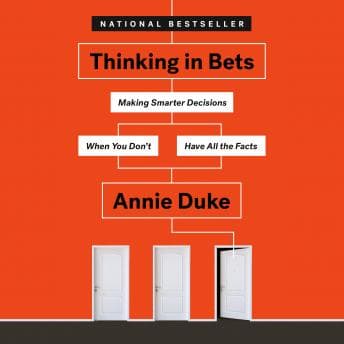

Look, I'm going to be honest - I was skeptical going in. Another business book about decision-making? I've sat through enough McKinsey presentations on risk matrices to last several lifetimes. But Annie Duke's Thinking in Bets is the rare case where a poker player actually has something useful to teach the rest of us. And at under 7 hours, she respects your time. That alone puts her ahead of 80% of the business books on my Audible shelf.
The Pete Carroll Problem
The book opens with that infamous Super Bowl play - the Seahawks pass that got intercepted when everyone expected a handoff to Marshawn Lynch. Duke uses it to make her central point: we judge decisions by their outcomes, not by their quality. Carroll's call wasn't necessarily wrong. It just didn't work.
This is the kind of thing my parents understood instinctively running their dry cleaning business. Sometimes you make the right call and it still blows up in your face. Sometimes you get lucky. The difference is learning to separate the two. Duke calls this "resulting" - our tendency to conflate good outcomes with good decisions and bad outcomes with bad decisions. It's a cognitive trap I've watched destroy client companies.
Why Author-Narration Works Here
Duke narrates her own book, and honestly? She nails it. There's a warmth to her delivery that makes the poker analogies feel accessible rather than insider-y. She's not performing - she's explaining. Like she's walking you through a hand at a friendly game, not lecturing from a podium.
The pacing is solid. Good energy without being manic. I listened at my usual 2.0x and it held up fine. Some business audiobooks fall apart at higher speeds - the narrator's breathing gets weird, or the pauses become jarring. Not here. Clean production, clear delivery.
Now, is it perfect? No. There are stretches in the middle where she's circling the same concepts with different examples. Could've been tighter. My wife Jenny would say I'm being harsh - and maybe I am - but when you've listened to as many padded business books as I have, you notice the filler. It's not egregious, but it's there.
The Framework That Actually Sticks
The core idea is genuinely useful: treat your beliefs like bets. How confident are you, really? 60%? 85%? Forcing yourself to assign probabilities to your assumptions changes how you think about uncertainty. I've started using this with clients. "How sure are we that this market expansion will work? Give me a number." It cuts through the false confidence that kills strategic planning.
Duke also introduces the concept of "decision groups" - finding people who will challenge your thinking rather than confirm it. This is harder than it sounds. The same dynamic shows up in relationships—Wired for Love makes the case that secure partnerships require the same kind of honest feedback loops, just in a different context. Most of us surround ourselves with people who agree with us. (Yes, I'm guilty of this too.) She makes a compelling case for deliberately seeking out dissent.
The poker examples are everywhere, but they work because she translates them well. You don't need to know Texas Hold'em to follow along. The business and sports examples provide enough variety to keep it grounded.
Who Gets ROI Here (And Who Won't)
If you're in any role where you make decisions under uncertainty - founders, managers, consultants, investors - this is worth your time. The framework is practical and immediately applicable.
Skip it if you're looking for entertainment. This is a thinking book, not a story. It's well-constructed, but it's fundamentally about cognitive psychology applied to decision-making. If that sounds dry to you, it probably will be.
For the commute crowd: perfect fit. The chapters are discrete enough that you can pause and pick up without losing the thread. I finished it over about a week of LA traffic, and it made the 405 slightly less miserable.
The Dry Cleaner's Son's Take
This is what my parents did instinctively - separating luck from skill, learning from bad outcomes without overcorrecting. Now it has a framework and a TED talk. Duke packages it well, delivers it cleanly, and doesn't waste your time with unnecessary padding. At 6 hours and 51 minutes, it's one of the more efficient business audiobooks I've encountered. Not everything lands, but the core ideas are solid enough that I've already recommended it to three clients this quarter.
Would I listen again? Probably not cover to cover. But I've got the key chapters bookmarked for when I need a reset on my own decision-making. That's more than I can say for most of what's sitting unfinished in my library.