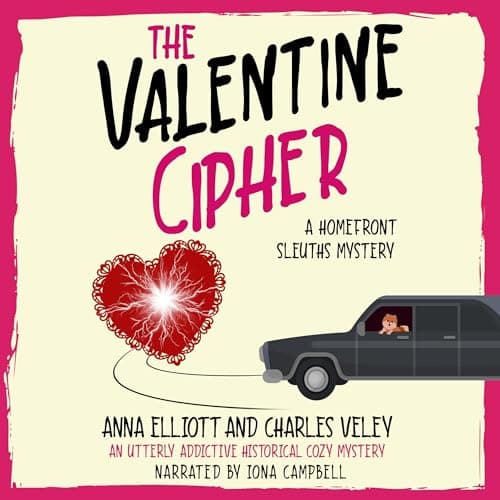

Can a retired colonel who spent three tours dodging IEDs genuinely enjoy a cozy mystery about Valentine's Day weddings in wartime England?
Turns out, yes. And I'm as surprised as you are.
I picked up The Valentine Cipher on a whim - Linda had surgery on her knee last week, and I've been doing the midnight-to-four watch while she sleeps. Ranger sprawled across my feet, house dead quiet, and thirteen hours of village intrigue seemed like the right kind of company for those long, still hours. What I didn't expect was how sharp this book actually is underneath all the lace and wedding preparations.
Seven Brides and a Dead Curate Walk Into a Village
Let me cut to the chase: the setup here is deceptively simple. Crofter's Green is throwing a massive Valentine's Day wedding for seven couples, a "very important" guest is expected (the book plays coy about her identity but come on - it's pretty clear who the most famous woman in wartime England would be), and the village curate turns up dead days before the ceremony. That's your hook. But the cipher subplot - Evie and Nigel intercepting a Norwegian spy's coded message with the dead curate's name buried in it - that's where Elliott and Veley show they've actually done their homework on wartime intelligence operations.
The cipher mechanics aren't just window dressing. The book treats codebreaking with enough respect that I wasn't grinding my teeth, which is more than I can say for most historical thrillers that wave "Enigma" around like a magic word. Is it Bletchley Park-level accurate? No. But for a cozy mystery, the tradecraft details land somewhere between respectable and surprisingly competent. Lightning Rod is another one that actually respects its readers enough to get the intelligence tradecraft right without turning the whole thing into a lecture.
Iona Campbell Owns This Village
Here's what got me - and what kept me up past my watch shifts. Campbell's narration doesn't just differentiate the five main sleuths, she makes each of them sound like someone you'd recognize. Harry's got this steady, measured authority that reminds me of every good NCO I ever served with. Evie's voice carries a sharpness that Campbell plays against Nigel's more cautious tone in a way that tells you about their relationship without the text doing any heavy lifting.
The British accents are authentic - not the exaggerated BBC stuff Americans think British people sound like, but actual regional variation. Village characters sound different from London characters. That's a detail most narrators don't bother with, and Campbell clearly does. At 1.25x she still sounds natural, which is my personal benchmark for good narration pacing.
The Cozy Problem (And Why It Mostly Works Anyway)
I'll be honest - this is book eight in a series, and I jumped in cold. There's a warmth between the characters that clearly comes from seven books of history I haven't lived through with them. Some emotional beats between Evie and Nigel felt like I was walking into the middle of a conversation at a party. Not a dealbreaker, but I was aware of it.
The mystery itself follows cozy conventions pretty faithfully. Suspects are introduced, each bride gets her moment of suspicion, and the resolution ties up clean. Too clean for my taste - real investigations are messier, and the way evidence falls into place felt a bit convenient in the final hours. But that's the genre. You don't order a beer and complain it's not whiskey.
What saves it from being just another cozy is the wartime backdrop. Elliott and Veley use the war not as set dressing but as actual pressure on these characters' decisions. The question of which bride is hiding a deadly secret carries weight because in 1940s England, secrets could literally get people killed. That jump from village gossip to national security is the engine that keeps thirteen hours from dragging.
Mission Debrief
Worth your time? Here's the debrief. At nearly thirteen hours, this is a commitment, and it earns most of that runtime. The cipher subplot gives the story genuine tension, Campbell's narration is the kind of performance that makes you forget you're listening to one person, and the Valentine's Day setting adds just enough romantic complication without turning saccharine.
Who should listen: If you like cozy mysteries with actual historical teeth - wartime espionage, real cipher work, stakes beyond a stolen scone recipe - this one delivers. Who should skip: If you need hard-boiled pacing or can't stomach wedding subplots, this isn't your op.
Is this my usual fare? Not by a long shot. But sitting in the dark at 0300 with Ranger snoring and Linda sleeping peacefully down the hall, I found myself genuinely wanting to know which bride was the traitor. And I didn't guess right, which - from someone who's spent decades reading threat assessments - counts for something.
Ranger slept through the whole thing. But I think he'd approve.