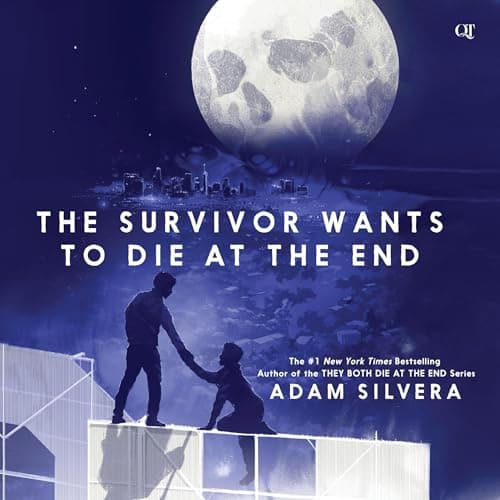

Adam Silvera wrote a book where the main character wants to die, and he made me care so much about that character's survival that I nearly missed my exit walking the lakefront with Denise last Tuesday evening. She had to pull me by the arm because I was standing frozen at the Montrose Harbor turnoff, eyes wet, listening to Frankie J. Alvarez choke through Paz's narration like he was living it.
Let me back up.
The Death-Cast Kid Who Wants the Phone to Ring
The premise of the They Both Die at the End series has always been clever — Death-Cast calls you on the day you're going to die, so you can live your last hours fully. But The Survivor Wants to Die at the End inverts that whole conceit in a way that genuinely surprised me, even after teaching dystopian fiction to teenagers for two decades. Paz Dario stays up every night hoping for the call. Not because he wants to live his last day fully. Because he wants it to be over. And when Death-Cast doesn't call, he decides to handle things himself.
That's a hell of a setup for a YA novel. Silvera isn't playing it safe here, and the content warnings exist for good reason. This reminds me of what Hemingway said about writing — you have to sit down and bleed. Silvera clearly did. The same willingness to go to genuinely uncomfortable places is what made Verity stick with me long after I finished it — though Silvera is kinder to his characters than Colleen Hoover is.
Paz's counterpart, Alano Rosa, is the heir to the Death-Cast empire itself, which creates this fascinating tension. One boy wants the system to claim him. The other boy is trapped inside the system that claims everyone else. Their collision isn't just romantic — it's ideological. Silvera is really asking something here about institutional power and personal agency, dressed up in a sci-fi hoodie. My students would hate me for saying that. I love it.
Three Voices, Three Frequencies
The multi-narrator setup is where this audiobook earns its format. Frankie J. Alvarez doesn't just read Paz — he inhabits him. There's a moment where Paz yawns mid-sentence, and Alvarez actually yawns. The giggles feel unrehearsed. When Paz cries, Alvarez's voice breaks in that ugly, real way that acting coaches can't teach. The narrator understands that pause is punctuation. I was grading sophomore essays at 11 PM and had to put my red pen down because I couldn't see through the blur.
Anthony Rey Perez takes the opposite approach with Alano — quiet, steady, a slightly growly quality to his delivery that suggests someone who's learned to keep his real feelings two inches below the surface. It's a smart contrast. Where Alvarez is all exposed nerve, Perez is the slow simmer. His work in the ending chapters — and I won't spoil it — hit me harder than I expected precisely because he'd been so controlled up to that point.
Kyla Garcia handles the interludes and secondary perspectives, and she's the connective tissue holding the whole production together. She shifts between characters and tonal registers without making it feel like a performance. It just feels like the book breathing between its two heartbeats.
Where Silvera's Reach Exceeds His Grip
At nearly eighteen hours, this is a commitment. And I'll be honest — the middle third drags in places where the plot mechanics of the Death Guard (the violent anti-Death-Cast organization) feel more like genre obligation than organic story. Silvera is strongest in the intimate scenes between Paz and Alano, the conversations where two people who shouldn't understand each other suddenly do. The thriller elements around Alano's safety feel like a different, less interesting book trying to muscle its way in.
The callbacks to They Both Die at the End and The First to Die at the End are genuinely satisfying if you've been with the series, but I suspect newcomers would feel lost in about a dozen moments. This isn't a standalone. Don't start here.
But Silvera's handling of suicidal ideation — careful, unflinching, never glamorized — is the best I've encountered in YA fiction. The prose deserves to be savored. He doesn't offer easy answers or magic-cure love stories. Paz doesn't get better because a cute boy shows up. He gets better because surviving is a choice he keeps making, sometimes minute by minute. That's honest writing.
Worth Pausing the Faculty Meeting For
If you loved They Both Die at the End, this is its spiritual successor — and in some ways, its most emotionally ambitious chapter. The three narrators justify the audiobook format completely. You'd lose something reading this in print. You'd miss that yawn, that growl, that crack in the voice at hour sixteen that made me stand still at a harbor while my wife waited.
Principal Martinez, if you're reading this — no, I was not listening to this during your facilities update. (I absolutely was.)









