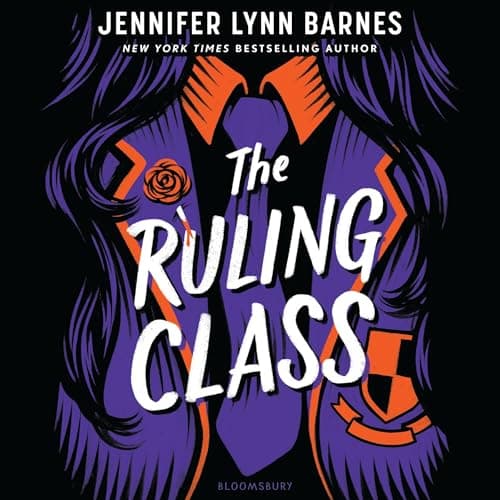

Most people seem to come to this book because they loved The Inheritance Games and want more Jennifer Lynn Barnes. I came at it sideways — I was looking for a smart YA audiobook to burn through during a week of long commutes, and the D.C. political fixer premise caught my eye. Here's the thing: this is actually a repackaged edition of Barnes's earlier novel The Fixer, and knowing that context shifts how you receive it. It's not quite the polished machine that The Inheritance Games became, but it's got its own scrappy energy that I genuinely enjoyed.
The setup is straightforward but effective. Tess Kendrick gets shipped off to live with her older sister Ivy in Washington D.C., only to discover that Ivy is basically Olivia Pope for the political elite — a fixer who makes problems disappear. When Tess enrolls at Hardwicke School, the exclusive playground of senators' kids and lobbyists' daughters, she stumbles into her own version of the family business. Students start coming to her with their problems, and Tess discovers she has a knack for untangling the kind of messes that powerful families desperately want to keep quiet.
What Barnes does well — and what she's always done well — is build systems of power and then drop a smart, slightly outsider protagonist right into the middle of them. Tess isn't wealthy. She doesn't belong at Hardwicke. But she's observant and stubborn, and watching her navigate the social hierarchies of D.C.'s most connected teenagers scratched the same itch as watching Avery Grambs figure out the Hawthorne family. The political backdrop gives the story a different flavor though. There's a cynicism to the D.C. setting that makes the stakes feel both higher and more grounded than a billionaire's mansion. I noticed a similar grounded quality in Divergent — that sense of a teenager suddenly reckoning with systems of power much larger than themselves, even if the setting there is considerably more dystopian.
Ina-Marie Smith's narration carries the audiobook effectively. She keeps the pacing tight and matches the book's quick-moving energy without rushing through the quieter character moments. Her reading feels confident and assured — she understood the assignment, which was to keep you turning pages (or in this case, keep your earbuds in for just one more chapter). I wouldn't call it a standout performance that transforms the material, but it's clean, professional work that never gets in the way of the story. For a book that depends on momentum and reveals, that's exactly what you need.
The mystery at the center of the plot builds nicely through the first two-thirds. Each problem Tess fixes for a classmate peels back another layer of the larger conspiracy connecting Hardwicke to Capitol Hill. Barnes clearly drew on her academic background in psychology and cognitive science — Tess reads people the way a profiler might, picking up on microexpressions and contradictions in what people say versus what they do. If you've read The Naturals, you'll recognize this approach, though here it's put to work in service of political intrigue rather than criminal profiling.
Where the book loses some steam is in the final act. The convergence of Ivy's fixer world and Tess's school-based investigation should feel like a collision, but it lands more like a controlled merge. Some of the reveals are telegraphed a bit too clearly, and a couple of the secondary characters who seemed important early on kind of fade into the background when the real plot kicks in. It's not a dealbreaker — the pacing stays brisk enough that you don't dwell on it — but it kept me from being fully blown away by the conclusion.
The sister dynamic between Tess and Ivy is actually the emotional core that holds everything together. Both are living double lives, both are keeping secrets from each other, and both are more alike than either wants to admit. Barnes handles their relationship with real specificity — the mix of resentment, admiration, and protectiveness felt authentic in a way that a lot of YA sibling relationships don't bother to achieve.
At just over ten hours, this is a perfect commute or road trip listen. It's plotted to keep you engaged without demanding your full concentration at every moment, though you'll want to pay attention during the key reveal scenes. The chapters are structured almost episodically — each "case" Tess takes on is its own mini-puzzle — which makes it easy to pick up and put down without losing the thread.
The content warnings for violence and some mature themes are worth noting if you're considering this for younger YA readers, though nothing here goes beyond what you'd find in a typical network TV political thriller. Think Scandal meets Gossip Girl, pitched at a smart sixteen-year-old.
Who Should Listen (And Who Should Skip)
If you're a Barnes fan who's already devoured The Inheritance Games and want to see where she honed her craft, this is well worth the listen. Same goes for anyone who digs political intrigue with a YA edge, or who just needs a propulsive audiobook for a long drive. Skip it if you're expecting the same level of tight plotting as her later work — this is earlier Barnes, and the seams show a little more, especially in the back half.
Is this Barnes's best work? No — I think The Inheritance Games series is tighter and more inventive. But as an earlier effort that shows the blueprint for everything she'd later perfect, it's satisfying in its own right. And honestly, the D.C. setting gives it a flavor I wish she'd return to. There's something about teenagers navigating actual political power that hits differently than puzzles and inheritances.









