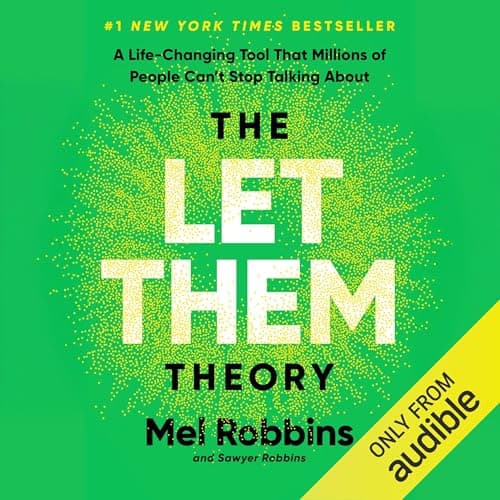

I was folding laundry at 6:45 AM on a Tuesday—half-awake, slightly annoyed at the pile of socks that never seems to shrink—when Mel Robbins told me to stop trying to control my teenager's attitude and just... let them. I actually stopped mid-fold and said out loud, to no one, 'Huh.' That's kind of the whole experience of this audiobook in a nutshell: a moment of clarity delivered while you're doing something mundane, by a woman who sounds like she's sitting across from you at a kitchen table.
Executive Summary: A practical, sticky two-part framework—"Let Them" plus "Let Me"—that helps you stop burning mental capital on things you can't control and reinvest it where it actually compounds. Slightly long, noticeably repetitive, but the ROI on the core idea is real. Robbins narrates it herself and her delivery is the product's biggest differentiator over print.
The Let Them Theory is built on a deceptively simple premise: you waste enormous amounts of energy trying to manage other people's behavior, opinions, and choices. The fix? Two words. Let them. Let them judge you. Let them leave the party early. Let them not text back. Then—and this is the crucial second half Robbins pairs with it—the 'Let Me' piece, where you redirect that recovered energy toward your own goals, boundaries, and happiness. It's not revolutionary philosophy. Robbins herself acknowledges she didn't invent the concept of letting go. But what she's done is package it into a framework that's sticky, practical, and genuinely applicable across relationships, careers, and the daily frustrations that eat you alive if you let them.
Robbins narrates the book herself, and this is where the audiobook earns its keep over the print version. Her delivery is punchy and direct—she doesn't whisper affirmations at you or wrap everything in therapy-speak. She talks like someone who has been exactly where you are, burning mental energy on a coworker's passive-aggressive email or a friend who didn't show up when it mattered. That texture of real life bleeding into the narrative is something I also found in In Real Life, where the messy, unglamorous parts of how people actually behave carry more weight than any tidy lesson ever could. Her personal anecdotes—about her marriage, her kids, her own spirals of control—land with real emotional weight because you can hear the catch in her voice or the laugh that comes from hard-won self-awareness. When she talks about trying to micromanage her daughter's social life and having to physically stop herself, you believe her, because she sounds like she's still a little embarrassed about it.
The book is structured around eight life areas where the Let Them framework applies, and Robbins pulls in research from psychology and neuroscience to back up what might otherwise feel like a bumper sticker. She references experts, cites studies on rumination and cortisol, and connects the dots between chronic people-pleasing and actual physiological stress responses. It's not a dense academic text, but it's not fluff either. She's found a sweet spot between accessible and substantive that works well in audio format.
Now, the honest part: this book is repetitive. The phrase 'let them' appears so frequently that by hour five, it starts to lose its shape in your brain, the way any word does when you say it too many times. Robbins also leans heavily on the word 'unpack'—she unpacks concepts, unpacks feelings, unpacks stories—and after a while, you start wishing someone would hand her a thesaurus. If you're the kind of listener who gets irritated by repetition, you'll feel it here. Some chapters cover ground that earlier chapters already established, and the distinctions between life areas can feel thin.
But here's what I keep coming back to: the repetition is also kind of the point. Robbins isn't writing for people who internalize a concept on first hearing. She's writing for people who need to hear 'stop controlling things you can't control' seventeen different ways before it actually sinks in. And honestly? As someone who listened to this across two weeks of morning routines and grocery runs, the repetition worked on me. The framework started showing up in my thinking unprompted. My partner made a decision I disagreed with, and instead of launching into my usual three-point argument, I caught myself and thought, 'Let them.' It felt like dropping a heavy bag I didn't know I was carrying.
The audiobook runs just under eleven hours, which is slightly long for what could have been a tighter eight-hour listen. At 1.25x speed, it flows better and trims some of the repetitive padding without losing Robbins' natural cadence. She speaks at a conversational pace that holds up well when slightly accelerated.
Compared to something like The Subtle Art of Not Giving a F*ck, which covers adjacent territory with more irreverence and humor, Robbins' approach is warmer and more structured. Mark Manson makes you laugh and then punches you in the gut; Robbins sits with you and walks you through the steps. Neither is better—it depends on whether you want a wake-up call or a game plan. Robbins gives you the game plan.
Who Should Listen (And Who Should Skip)
If you spend your commute replaying conversations, stressing about what people think, or trying to fix everyone around you—this audiobook delivers a genuinely useful mental tool with a real-world return. Skip it if you already have a solid handle on boundaries and emotional regulation; you'll find the repetition more annoying than reinforcing. Robbins' voice carries it. The framework sticks. And the laundry somehow felt lighter.