
I was walking the lakefront with Denise last Sunday - one of those late October mornings where Chicago pretends it's still autumn before winter drops the hammer - and I hit the final hour of Streets of Laredo. Denise asked me why I'd stopped talking. I told her Captain Call had just done something that broke me. She patted my arm and said "You and your cowboys." She's not wrong. But McMurtry's cowboys aren't really cowboys anymore by this book, and that's the whole point.
The Last Ride Nobody Asked For
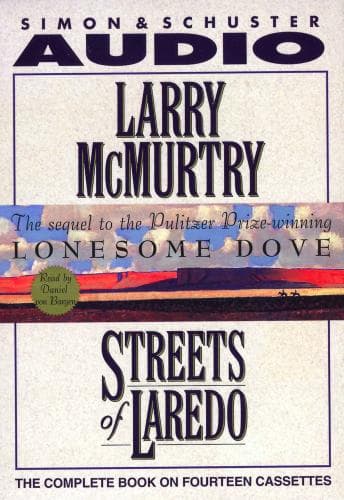
Let me set the table. Streets of Laredo is the final novel in the Lonesome Dove tetralogy, and McMurtry is doing something ruthless here: he's dismantling his own mythology. Captain Woodrow Call, the iron-willed Ranger we remember, is now a bounty hunter. He's old. He's diminished. The West he conquered is being crisscrossed by railroads, and the people hiring him are corporate men in offices, not frontier settlers. The erosion of a man who once seemed untouchable — watching him become a tool for people he'd have despised in his prime — is the kind of slow devastation that stuck with me the same way Ruthless King did, though McMurtry's version trades boardrooms for open range and arrives at something considerably darker. This reminds me of what Hemingway said about the world breaking everyone - McMurtry takes that idea and stretches it across 21 hours of Texas hardpan.
Pea Eye Parker married Lorena. That detail alone carries so much weight if you've lived with these characters through Lonesome Dove. Lorena - Gus McCrae's sweetheart - now raising children on a farm, trying to build something civilized while Call drags her husband back into violence. McMurtry doesn't sentimentalize any of it. The brutality is constant and unglamorous. A young Mexican bandit named Joey Garza is the quarry, and he's not some romantic outlaw. He's cold, efficient, and modern in a way that makes the old Rangers look like relics. Which they are.
McMurtry is writing an elegy disguised as an adventure novel. The prose deserves to be savored - those long stretches of landscape description where nothing happens and everything happens, where characters think about who they used to be while riding toward something that might kill them. My students would hate this. I love it.
Daniel Von Bargen and the Problem of Ghosts
Here's where it gets complicated. Daniel Von Bargen narrates this with the voice of an old man, and that's actually a smart interpretive choice. Call is old. Pea Eye is old. The West itself is dying. Von Bargen sounds like someone telling you a story they're not sure they want to finish, and for the first five or six hours, that weariness works.
But.
21 hours is a long time to sustain that register. The pacing is genuinely slow - not contemplative-slow, but sometimes sluggish-slow, where McMurtry's mental side trips (and he takes plenty) feel like they're being read through molasses. There's a monotony to Von Bargen's delivery that flattens moments that should hit harder. When McMurtry shifts to Lorena's perspective, or to the terrifying practicality of Joey Garza, I wanted vocal differentiation that just wasn't there.
And then there's the name problem. If you listened to the original Lonesome Dove audiobook, certain character names are pronounced differently here. It's the kind of thing that shouldn't matter but absolutely does - like hearing someone mispronounce a friend's name at their funeral. It pulls you out. Every time.
The narrator understands that pause is punctuation, and Von Bargen does get that right in quieter moments. There's a gravity to his reading that fits McMurtry's late style. But I kept wondering what this would've sounded like with a narrator who could shift gears - who could make Lorena's chapters feel distinct from Call's chapters, who could make Joey Garza sound genuinely dangerous instead of just described as dangerous.
Who Should Saddle Up (And Who Should Ride Past)
If you loved Lonesome Dove, this is its spiritual successor in the truest and most painful sense. McMurtry isn't giving you more of the same. He's showing you what "more" costs. That's a gutsy move for a sequel, and the writing earns it - the themes of obsolescence, of violence as habit rather than heroism, of love that survives despite geography and stubbornness. It's classic McMurtry.
But here's my honest advice: this audiobook requires dedication. Not background listening. Not workout fuel. You need to be sitting down or walking slowly, giving it your attention, because the pacing demands patience and the narration won't carry you through the dry stretches. If slow-burn Westerns aren't your thing, or if you need vocal variety to stay locked in over 21 hours, this might test you.
For McMurtry completists, for people who understand that the best Westerns are really about loss - worth your time. Just know what you're signing up for.
Worth Pausing the Faculty Meeting For (Almost)
Streets of Laredo is a great novel with a serviceable audiobook performance. McMurtry's writing does most of the heavy lifting, and Von Bargen carries it without dropping it - but without elevating it either. I'm glad I listened. I'm glad I walked the lakefront while I did, because something about Lake Michigan in late October and the dying Texas frontier felt like the same kind of beautiful, stubborn sadness. But I'd be lying if I said I didn't check the remaining time more than once during those middle hours. The book is a 4. The audio experience knocks it down a step.