
What if the best novels aren't really about plot at all?
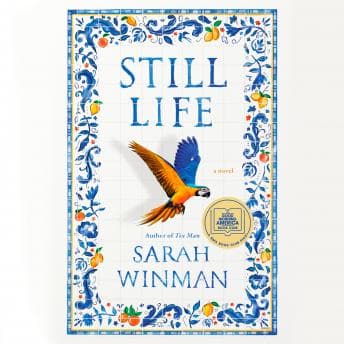
I've been teaching literature long enough to know that question gets me in trouble with curriculum committees. But I found myself turning it over like a worry stone while walking the lakefront with Denise last Sunday, Sarah Winman's voice in my earbuds, the Chicago wind doing its level best to freeze my face off. *Still Life* had just delivered a fifteen-minute stretch about the 1966 Florence flood—the Arno rising, mud swallowing Renaissance art, volunteers forming human chains to save waterlogged manuscripts—and I'd stopped walking entirely. Denise had to double back for me. "You're doing that thing again," she said. She wasn't wrong.
The Author Reading Her Own Love Letter
Here's what Winman understands that so many contemporary novelists don't: the pause is punctuation. When she reads her own prose—and she wrote this thing, so she knows exactly where the breath belongs—you hear the architecture of each sentence. Her voice drops to something almost conspiratorial when Ulysses and Evelyn first meet in that Tuscan wine cellar in 1944, two strangers finding each other amid the rubble of a world falling apart. Then it lifts, brightens, when she shifts to Claude the parrot.
Ah, Claude. A cantankerous talking bird who steals every scene he's in. Winman voices him with this scratchy, imperious quality—somewhere between a disapproving grandmother and a pub regular who's had one too many. My students would absolutely hate how much time this book spends on a parrot. I love it.
The character differentiation is genuinely impressive. Ulysses sounds like the East End working-class lad he is. Evelyn carries a kind of weathered academia in her vowels. The Italian characters get their own rhythms without tipping into caricature. This is what I mean when I tell my AP Lit kids that great narration is performance art—Winman isn't reading, she's interpreting.
Why Your Faulkner-Loving Heart Will Ache
Let me be honest about something: this book requires patience. Fourteen hours and fifty-four minutes of patience, specifically. Winman doesn't use quotation marks—the dialogue flows into the prose like watercolors bleeding at the edges—and if you're listening while doing something else, you will lose the thread. I tried grading papers during chapter three. Disaster. Had to rewind twenty minutes.
But if you give it your attention? This reminds me of what Hemingway said about Paris being a moveable feast—except Winman's feast is Florence, and it spans four decades, and it's populated by the kind of found family that makes you ache for people who don't actually exist. At 1.0x. (My students think I'm ancient for this take. They're not wrong.)
Some characters do disappear for long stretches—there's a painter named Massimo who shows up, becomes essential, then fades into the background for what felt like hours before resurfacing with diminished importance. The narrative breathes in a way that can feel slow if you're expecting traditional pacing. But Winman isn't writing a thriller. She's writing about how time moves through lives, how art survives catastrophe, how a group of misfits in a London pub can become more family than blood ever was.
The E.M. Forster of It All
The ghost of Forster hangs over this book—literally, he appears as a character—and Winman is clearly in conversation with *A Room with a View*. The Italy of repressed English tourists discovering passion. The question of whether beauty can save us, or whether that's just something we tell ourselves. But where Forster was precise and ironic, Winman is lush and earnest. She believes in her characters' capacity for love in a way that could feel naive if she weren't so clear-eyed about their failures.
I found myself thinking about this during Principal Martinez's budget meeting last Tuesday. (Martinez, if you're reading this: I was definitely paying attention to the facilities allocation discussion. I was not, in fact, listening to the Florence flood sequence again because I wanted to hear how Winman handles the moment when the water recedes and the volunteers see what's been lost.) The book asks whether we can rebuild after destruction—cities, yes, but also people. And it doesn't offer easy answers.
Who This Is (and Isn't) For
Anyone who loved *A Gentleman in Moscow* for its patient accumulation of joy—this is your next listen. Anyone who thinks the best historical fiction uses the past to illuminate how we live now. Rich People Problems does something similar with its sprawling family saga, though with considerably more humor and considerably less Florence. Anyone willing to surrender to nearly fifteen hours of prose that moves like honey—slow, golden, and worth every minute.
But if you need plot momentum, you'll be frustrated. If dialogue without quotation marks drives you crazy, the audiobook won't solve that problem—you'll still sense the unmarked shifts and have to pay attention to catch them. And if you're planning to multitask, just don't. This isn't a background listen.
Mr. Williams's Final Bell
I finished *Still Life* on my walk home from school yesterday, the last chapter landing just as I turned onto my street. Stood on the sidewalk for a full minute after it ended, not ready to go inside and return to the real world. Denise found me there. "Good book?" she asked.
"The kind you don't want to end," I told her.
She rolled her eyes, but she was smiling. She knows me.