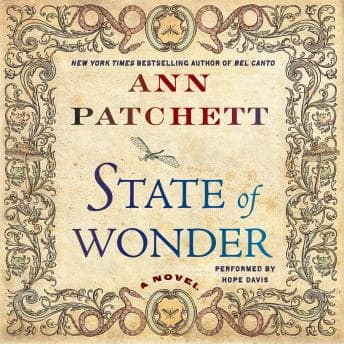

There's a moment early in this book where the humidity—the sheer, oppressive weight of the jungle—feels so real I actually checked the thermostat in my apartment. It was February in Chicago. My windows were frosted over. That's what Ann Patchett does. And that's what Hope Davis amplifies.
Look, I spend my days trying to convince 16-year-olds that Heart of Darkness is still relevant. (They don't buy it. They think Kurtz just needed a therapist.) But listening to State of Wonder is the closest I've come to feeling that specific kind of literary dread in years. It's a retelling, sure—Dr. Swenson is Kurtz, the Amazon is the Congo—but it's smarter. Patchett has a gift for taking familiar frameworks and making them feel urgent again—she does something similar with family dynamics in Dutch House: A Novel, though that one trades jungle heat for Philadelphia ice. It's about big pharma, ethics, and women who refuse to apologize for their genius.
The Voice That Haunted My Commute
Let's talk about Hope Davis. Usually, when a narrator tries to do accents—especially a mix of American, Australian, and German—I cringe. It's a reflex. I brace myself for a bad caricature that sounds like a villain from a 90s action movie.
But Davis? She nailed it.
She doesn't just "do voices." She inhabits the posture of the characters. When she speaks as the terrifying Dr. Annick Swenson, her voice drops. It gets clipped. Precise. You feel the intimidation. I found myself sitting up straighter in my car while stuck in traffic on Lake Shore Drive, feeling like I was about to get scolded for not reading the footnotes.
(And honestly, if a narrator can make me forget I'm sitting in bumper-to-bumper traffic, they deserve an award. Or at least a tenure-track position.)
Heart of Darkness in a Lab Coat
Here's the thing about the pacing—and I've seen the reviews. I know some people on the forums are complaining that it's a "slow start" or that it takes too long to get to the "action."
To them, I say: You're missing the point.
The slowness is the humidity. It's the waiting. It's the boat ride up the river. If Patchett rushed you into the jungle with a machete in chapter two, the ending wouldn't hit you like a freight train. And it does hit. The transition from the sterile labs of Minnesota to the chaotic, insect-riddled Manaus is jarring in the best way possible.
There are snakes. There are poison arrows. But the scariest thing in this book is the conversation. It's the moral ambiguity. Is Dr. Swenson a monster or a savior? Patchett refuses to give you the easy answer.
Why My Students Would Hate This (And Why I Love It)
My students want clear heroes. They want the good guy to win and the bad guy to fall off a cliff. This book doesn't do that. It's messy. The ending—which I obviously won't spoil—left me staring at my kitchen wall for a solid ten minutes while the pasta water boiled over.
Some listeners called the ending "abrupt." I call it honest. Life doesn't wrap up with a bow; sometimes it just stops, and you have to figure out how to carry the weight of what you just learned.
Hope Davis handles these quiet, devastating moments with a subdued urgency that is just... chef's kiss. She understands that silence is part of the text. She lets the prose breathe. Davis brings that same restraint to Commonwealth, where the family secrets need space to land without melodrama.
Who Should Queue This Up
If you're looking for a fast-paced thriller to zone out to at the gym? Skip this. Seriously. You'll be bored. But if you want a story that feels like a fever dream and makes you question the ethics of modern medicine while walking your dog? This is it.
(Just maybe don't listen to the snake parts right before bed. Learned that one the hard way.)