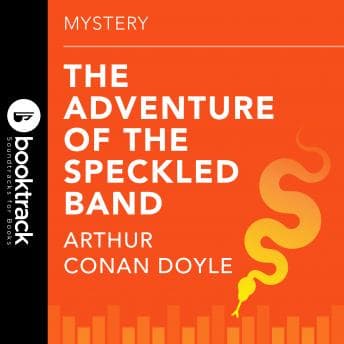

Look, I need to complain about something before we get into this: it's one hour and three minutes long. One hour. I've spent longer arguing with a sophomore about whether SparkNotes counts as reading. I finished this during a single walk along the lakefront with Denise, and when it ended she asked why I looked disappointed - not because it was bad, but because I wanted more. That's the cruelest thing a short audiobook can do to you.
Now. "The Adventure of the Speckled Band." If you've never read it, you've still somehow absorbed it through cultural osmosis - the locked room, the mysterious dying words of a terrified woman, the stepfather who keeps exotic animals on his English country estate like some Victorian-era Bond villain. Conan Doyle himself reportedly called this his favorite Holmes story, and honestly? He was right. This is the story where the formula clicks perfectly: the client arrives desperate, Holmes observes what everyone else misses, and the solution is both logical and genuinely unsettling. The dying whisper of "the speckled band" - Julia Stoner's last words to her sister Helen - carries this eerie ambiguity that Conan Doyle milks for every drop of tension. You think you know what it means. You're wrong. And then when you find out, it's worse than what you imagined.
Dr. Roylott Is the Real Reason We Still Read This
Let's talk about what Conan Doyle is really doing with Dr. Grimesby Roylott. He's not just a villain - he's Conan Doyle's argument that Empire corrupts. A man who went to India, came back violent and strange, keeps a baboon and a cheetah roaming his grounds, and has the physical menace to bend a fireplace poker with his bare hands. When Holmes quietly bends it back after Roylott storms out of 221B Baker Street, that's not just a flex - it's Conan Doyle telling you that intellect will always outmuscle brute force. I teach this story to my juniors every year, and that poker scene is the one that gets them. Every time.
Helen Stoner's visit to Holmes is also worth slowing down for. She arrives shaking, veiled, prematurely aged by fear. Conan Doyle gives her a speech about her sister's death that's genuinely haunting - the locked door, the metallic clanging in the night, Julia stumbling out convulsing and pointing. The prose deserves to be savored here, and at sixty-three minutes, you actually can.
The Soundtrack Question - And I Have Opinions
This is a Booktrack edition, which means they've layered in a movie-style soundtrack behind the narration. I'll be honest: I went in skeptical. I'm the person who listens at 1.0x because the author chose those words. Adding music felt like putting a laugh track on Shakespeare.
But here's the thing - for a one-hour mystery, it works better than I expected. The atmospheric scoring during the night scenes at Stoke Moran creates genuine tension. It's not overpowering; it sits underneath Mark Smith's narration like a film score should. That said, I can see it being distracting for purists, and there were moments where I wished I could strip it away and just sit with Conan Doyle's sentences. The production is clean, and Smith reads with steady clarity, but I don't have enough here to tell you he's doing anything extraordinary with character differentiation - at this length, with this format, the soundtrack is doing a lot of the heavy lifting that a narrator might otherwise handle through voice alone.
Smith is competent and clear. He doesn't get in the way. But "doesn't get in the way" is different from "transforms the material," and I want to be straight with you about that distinction. If you want a Holmes narrator who interprets every comma, this might leave you wanting. If you want a brisk, atmospheric experience that feels more like a radio drama than a traditional audiobook, you'll be satisfied.
Who Gets the Assignment
This is a gateway drug. If you've never read Holmes - and I say this as someone who has watched hundreds of teenagers discover these stories - start here, not with the novels. It's tight, it's spooky, and at an hour long, it asks almost nothing of your time. The soundtrack edition makes it feel like an event rather than a short story, which is smart packaging for newcomers.
My students would hate that I'm recommending the fancy soundtrack version. I love it. Though I'll admit, my tolerance for atmosphere over purity wavers depending on the book — I kept thinking about that tension while sitting with Spool of Blue Thread, which layers family dread so quietly that any soundtrack would have flattened it completely.
But if you're a Holmes veteran looking for a definitive audio performance, or if background music in your audiobooks makes you twitchy, this probably isn't your edition. Seek out a dedicated narrator who'll give you distinct Holmes and Watson voices and let the silence do its own work.
The Red Pen Says
One hour with Sherlock Holmes at Stoke Moran, a dying woman's cryptic last words, and a stepfather who keeps a swamp adder as a murder weapon. Worth pausing the faculty meeting for. Just don't expect it to last as long as the faculty meeting. (Nothing does. Nothing.)