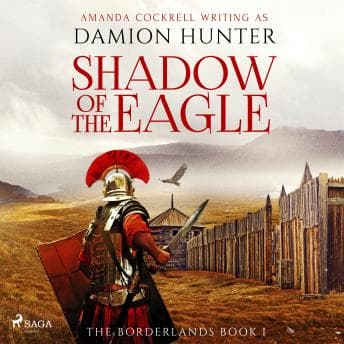

This is not my usual lane. I'm a fantasy guy - dragons, magic systems, progression mechanics, the whole deal. But I've been on a Rosemary Sutcliff kick lately (yes, the children's author, fight me, The Eagle of the Ninth still goes hard), and the algorithm served me Shadow of the Eagle while I was deep in a late-night coding session, trying to get a procedural terrain generator working and absolutely failing. So I figured: Roman Britain, dual heritage protagonist, Agricola's campaign north? That's basically a historical hex crawl. I'm in.
And honestly? I'm glad I took the detour.
Faustus Is the Half-Elf Ranger of Roman Britain
Here's what grabbed me about Faustus Valerianus: he's not just "man caught between two worlds" in the generic sense. His mother was a British captive - sold as spoils after Claudius' invasion - and his father was Roman, and when both die within a month of each other, he doesn't have some dramatic identity crisis. He just... enlists. Sells the farm and joins Agricola's push north. And the tension isn't loud or melodramatic. It's this quiet, persistent thing where he's marching into territory that his mother's people call home, carrying his father's expectations like a legionary pack, and neither side fully claims him.
If you've ever played a half-orc in a human city in D&D, you know this energy. You're functional, you're useful, but you're never quite of the group. Damion Hunter (who is actually Amanda Cockrell, which I didn't know until I finished the book and went down a rabbit hole) handles this with restraint. No big speeches about belonging. Just small moments - how Faustus reacts to British prisoners, how other soldiers clock his accent or his features, how he processes the landscape differently than the legionaries around him.
The world-building here is grounded in a way that historical fiction sometimes isn't. Cockrell clearly knows her Roman military logistics, camp construction, supply chain headaches. If you don't like info-dumps, this isn't for you (but you're wrong). The detail about daily camp life during the Agricola campaign - the mud, the routine, the bureaucratic absurdity of empire at its edges - that stuff landed for me. My D&D group would love this as campaign setting research.
Andrew Kingston and the Voice Differentiation Problem
Okay. Andrew Kingston. He's solid. His pacing is good - he finds a rhythm that works for march-and-camp chapters and doesn't rush through the action sequences. His baseline narrator voice has this measured, slightly formal quality that fits the Roman military setting well.
But - and this is where I have to be honest - some of the character voices blur together. When you've got multiple Roman soldiers in conversation, it can be hard to track who's speaking without the dialogue tags. Kingston doesn't quite nail distinct enough vocal signatures for the secondary military characters. The British characters fare a bit better; there's a shift in register and cadence that helps. But in a mess tent scene with three or four legionaries? I had to rewind a couple times.
Steven Pacey walked so other narrators could run, and Kingston isn't quite at that level of character differentiation. He's competent and professional - this isn't a bad performance. It's just not one that elevates the material the way a top-tier narrator would. For 13+ hours, you want voices that stick, and only Faustus and maybe two others really did.
The Pacing Tax on Agricola's March
At 13 hours 23 minutes, this is a commitment. And the pacing is... uneven. The first third is genuinely absorbing - Faustus establishing himself, the early campaign movements, the world taking shape. The middle section drags in places where the political maneuvering between Roman officers gets repetitive. There are conversations about command decisions that could've been trimmed without losing anything.
But then the final act picks up significantly. The campaign pushes into genuinely hostile territory, and the consequences of Faustus's dual heritage stop being subtext and start being plot. That payoff is earned, even if you have to wade through some slower hours to get there.
I will say: the predictability criticism I've seen floating around isn't entirely unfair. If you've read Ben Kane or Simon Scarrow, you'll see some beats coming. But the execution is warm and specific enough that I didn't mind. Not every book needs to subvert expectations. Sometimes the progression is satisfying because you want to see this character earn his place.
Roll for Persuasion: Who Should March With Faustus
If you're into Roman historical fiction - Scarrow, Kane, Cornwell's Saxon Stories - this is a strong entry. The dual-heritage angle gives it something the standard "Roman legionary fights barbarians" formula doesn't always have. If you need breakneck pacing or constant battle sequences, the middle section will test you. And if narrator voice differentiation is a dealbreaker, maybe read the print version instead.
I read this instead of writing my thesis. Dr. Patel would not approve. But I regret nothing. The same guilt hit me when I burned a weekend on All the Light We Cannot See - another slow-burn historical with a protagonist caught between inherited identity and impossible circumstance, and another book that absolutely wrecked my productivity in the best way.
This isn't Sanderson-level world-building - it's a different beast entirely, more restrained, more historical. But the care that went into the setting and the quiet complexity of Faustus as a protagonist? That's real craft. Worth the 13 hours. Even the slow ones.