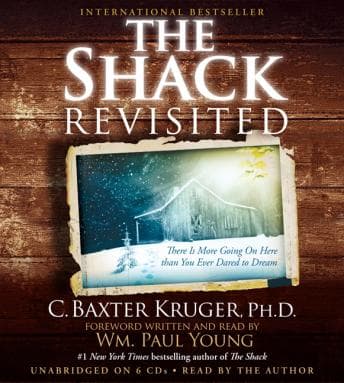

This is a theology book disguised as a literary companion, and I mean that as both compliment and warning.
I came to The Shack Revisited sideways. I'd assigned The Shack as a summer reading option for my juniors a few years back — one of those books that gets kids arguing about God in a way that catechism class never managed. So when Kruger's companion piece showed up in my recommendations, I figured I'd give it a listen during one of those Saturday morning lakefront walks with Denise. She lasted about twenty minutes before putting in her own earbuds. "You're making your theology face," she said. She wasn't wrong.
The Professor Who Can't Stop Preaching
Here's the thing about Kruger narrating his own book: the man clearly knows this material the way I know the final pages of The Great Gatsby — bone-deep, lived-in, passionate to the point of breathlessness. And I mean that literally. He reads fast. Not excited-fast, not building-to-a-climax fast. More like seminary-lecture-where-he's-got-three-more-points-to-make-before-the-bell fast. There were stretches where I actually reached for my phone to check if I'd accidentally bumped the speed to 1.25x. I hadn't.
The preaching cadence is the real issue. Kruger has this rising-and-falling rhythm — thesis, expansion, emotional peak, reset — that works beautifully in a pulpit but gets exhausting over nearly seven hours of sustained listening. By hour three, I started losing the theological distinctions he was making about perichoresis (the mutual indwelling of the Trinity, for those of you who didn't spend a semester in divinity school electives) because the delivery flattened everything to the same urgency. When everything sounds like the most important thing he's ever said, nothing stands out.
I saw one listener's review that nailed it: they stopped listening entirely because the narration overwhelmed content they found genuinely fascinating. And that's the tragedy here. The substance deserves better than its delivery.
What Kruger Actually Gets Right About The Shack
Strip away the narration problems and there's a genuinely interesting argument underneath. Kruger isn't just explaining The Shack — he's using it as a Trojan horse for a specific strand of Trinitarian theology that most American evangelicals have never encountered. His core claim is that Western Christianity got so obsessed with legal metaphors for salvation (courtrooms, debt payments, transactions) that it forgot the Eastern church's older vision: God as a relationship so full of love it spills outward into creation.
This reminds me of what Hemingway said about writing — the dignity of movement of an iceberg is due to only one-eighth of it being above water. Young's novel was the visible eighth. Kruger is trying to show you the rest. He walks through why Papa appears as an African American woman, why Jesus is a Middle Eastern carpenter who likes to cook, why Sarayu the Holy Spirit is portrayed as shimmering and hard to focus on. These weren't arbitrary choices. Kruger argues they were theological statements about a God who refuses to be pinned to human power structures. The book of James wrestles with some of that same tension between lived faith and inherited religious structure, and the Bible (KJV) NT 20: James audiobook actually made me hear those verses differently than I ever had in print.
The strongest section — and I actually stopped walking and stood like an idiot on the bike path for this — is his breakdown of why Mack's encounter with Sophia (the personification of wisdom) is the theological hinge of the entire novel. Kruger connects it to the book of Proverbs and the early church fathers in a way that made me rethink a book I'd dismissed as somewhat sentimental.
The Audience Problem
So who is this for? That's where it gets complicated. If you loved The Shack and want to understand why it moved you, Kruger provides genuine intellectual scaffolding. He's not writing devotional fluff. But the audiobook format fights against his strengths. This is dense material — the kind of book where you want to underline sentences and sit with paragraphs. At 1.0x, Kruger's pace already feels like 1.3x, which means your brain is constantly playing catch-up with ideas that deserve slow absorption.
My students would hate this. I... mostly appreciated it, with reservations.
If you're coming in without affection for The Shack, this will feel like an elaborate defense of a book you didn't ask about. And if you're theologically opposed to Young's portrayal of God, Kruger isn't going to convince you — he's preaching to the converted. (Literally. He's preaching.)
Worth Slowing Down For — But Maybe Read It Instead
I finished it. I'm glad I did. But I'd be lying if I said the audiobook is the best way to encounter this material. The prose deserves to be savored, and Kruger's own narration doesn't let you savor it. He's so eager to share what he's discovered that he forgets the listener needs breathing room. Worth pausing the faculty meeting for? Parts of it, absolutely. The whole seven hours in audio form? I'd honestly suggest picking up the print edition and reading it at your own pace — which is advice I never thought I'd give on an audiobook review site.