
What if everything you learned in business school about leadership was backwards?
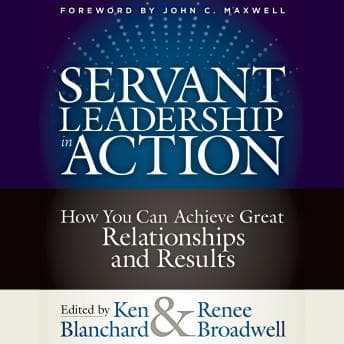
I was on a red-eye to Chicago, prepping for a client who'd just fired their third CEO in five years, when I started this one. Nearly ten hours of leadership content from the guy who wrote The One Minute Manager. At 2.0x speed, that's still a significant commitment. And honestly? About half of it earned that time.
The Blanchard Paradox
Here's the thing about Ken Blanchard compilations—you're getting a potluck dinner. Some dishes are incredible. Others are... church basement casserole. The contributor list reads like a LinkedIn influencer's dream: Simon Sinek, Brené Brown, Stephen M.R. Covey, Marshall Goldsmith. Heavy hitters. But when you throw 40+ voices into one book, quality control becomes impossible.
The strongest sections come from practitioners who've actually implemented servant leadership at scale—not just theorized about it. There's a Southwest Airlines case study that made me pause my playback (rare) because it illustrated exactly what my parents did running their dry cleaning shop in Koreatown. They never called it "servant leadership." They called it "not being a jerk to the people who make your business run." Now it has a TED talk and a ten-hour audiobook.
Skip to Section Three. Thank Me Later.
The book's organized into three parts: theory, models, implementation. Parts one and two are fine—decent conceptual framework, some inspirational examples. But section three, "Putting Servant Leadership to Work," is where the ROI lives. Real companies, real challenges, real results. That's the consulting mindset talking, but I've watched too many leadership initiatives die in the boardroom because nobody could answer "how do we actually do this Monday morning?"
The spiritual content caught me off guard. Religion & Spirituality is listed as a genre tag, and they're not kidding. Several contributors approach servant leadership from an explicitly faith-based perspective. If that's your thing, great. If you're looking for pure business application, be prepared to skip some chapters. I'm not opposed to it—my parents' work ethic was 100% rooted in their faith—but I needed tactical frameworks for my Chicago client, not theological foundations.
The Audio Experience (Such As It Is)
Jeff and Natalie Hoyt deliver clean, professional narration. That's the nicest thing I can say. It's also the most accurate thing I can say. For a compilation with contributions from wildly different personalities—Brené Brown's vulnerability research versus Marshall Goldsmith's executive coaching style—the narration feels oddly uniform. Like everyone's wearing the same business casual outfit.
No audio issues. No weird background noise. Just... competent. Jenny would say I'm being harsh. Jenny is right. But when you've got Sinek's voice in your head from his actual audiobooks, hearing someone else read his words feels like watching a cover band.
Who Gets Value Here (And Who Doesn't)
New managers who've never encountered servant leadership concepts will find this comprehensive. It's a solid introduction with enough variety to find at least a few contributors who click with your style. HR professionals building leadership development programs will appreciate the range of perspectives and case studies.
But if you've already read Blanchard's other work, or you've consumed Sinek's and Brown's books individually, you're getting the greatest hits album when you already own the studio recordings. Skip it—you'll just be nodding along to ideas you've already internalized.
Seasoned executives might find this too basic. I've seen the "serve your people" message fail at three different companies—not because the philosophy was wrong, but because implementation was treated as a feel-good initiative rather than a structural change. This book addresses that gap somewhat, but not deeply enough for anyone who's already in the trenches.
The Consultant's Bottom Line
This is a B+ textbook masquerading as a leadership manifesto. Solid information, professional production, but it's trying to be everything to everyone and ends up being pretty good for most.
My Chicago client ended up implementing exactly one concept from this book—the idea that organizational charts should be inverted, with leadership at the bottom supporting everyone else. Simple. Obvious, even. But sometimes obvious is what we need. I Am: The Power of Discovering Who You Really Are takes that same "obvious but necessary" approach to self-awareness—another foundational concept that gets overcomplicated.
Worth a credit if you're building a leadership library from scratch. Wait for a sale if you've already got Blanchard or Sinek on your shelf. At 2.0x speed during your commute, you'll extract the value in about five hours and move on with your life.
That's the efficiency my parents would've appreciated.