
Lemony Snicket's entire series is a case study in how children process trauma, and Book 9 is where that thesis gets genuinely uncomfortable.
I was making chana masala at 10 PM on a Wednesday — the kind of elaborate cooking my mother would approve of if she knew I was eating it alone over the sink — when Tim Curry's voice informed me that the Baudelaire orphans were about to disguise themselves as carnival freaks. And I thought: this is a children's book that's asking kids to sit with the ethics of deception, identity performance, and institutional prejudice. Dressed up in absurdist humor. Handed to eight-year-olds. Brilliant.
The Orphans Are Running a Long-Term Dissociation Experiment
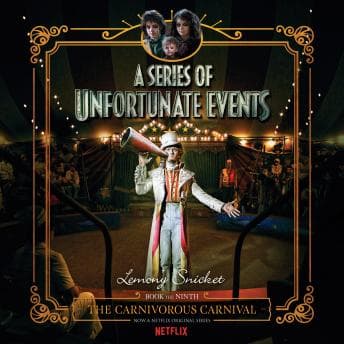
By Book 9, the Baudelaire children exhibit classic trauma responses that would make any developmental psychologist take notes. They've moved past shock, past grief, past the desperate hope that adults will help them. They're now actively manipulating their own identities to survive — Violet and Klaus literally hiding inside a single oversized costume to pass as a two-headed freak. Sunny pretending to be a wolf baby named Chabo. The protagonist exhibits classic adaptive identity fragmentation, and the series knows it.
What makes this installment different from the earlier books is that the moral universe has gotten murkier. The orphans aren't just victims anymore. They're making choices — lying, scheming, contemplating genuinely dark acts. Snicket frames this through his signature sardonic narration, constantly interrupting to define words and warn you to stop listening, but underneath the comedy there's a real psychological question: what happens to children's moral development when every authority figure either betrays them or dies? The research actually shows that prolonged exposure to unreliable caregivers produces exactly the kind of hypervigilance and precocious autonomy these kids display. Daniel Handler did his homework, whether he knows it or not. The closest I've come to seeing that same accidental-but-rigorous psychological framework applied to adult behavior is in 12 Rules for Life, which also smuggles serious developmental psychology into a package that reads much lighter than it actually is — though Peterson is considerably less fun about it than Snicket.
The carnival setting — Caligari Carnival, with its fortune-telling tent and lion pit — works as a metaphor I found myself chewing on long after the chana masala was gone. Carnivals are spaces where freakishness is commodified, where otherness is spectacle. The Baudelaires have been "othered" since Book 1 (orphans, targets, outsiders), and now they're literally performing that otherness for survival. I found myself asking: why does Snicket keep putting these children in spaces that mirror their psychological state? Because he's not writing adventure stories. He's writing about the experience of being powerless in a world that finds your suffering entertaining.
Tim Curry Understands That Irony Is a Defense Mechanism
Look, Tim Curry narrating Lemony Snicket is one of those casting choices that feels inevitable in hindsight. His dry, ironic delivery doesn't just match Snicket's tone — it IS the tone. The way he reads Snicket's authorial interruptions (those extended vocabulary definitions, the warnings to put the book down) lands with this specific weight where you can hear the smirk but also the sadness underneath it. That's hard to pull off. Most narrators would lean too far into camp or too far into melancholy. Curry finds the exact frequency where dark humor lives.
His character differentiation is strong — Count Olaf gets this oily theatricality that shifts when Olaf is in disguise versus when he's dropping the act, and the distinctions between the three Baudelaire children are consistent enough across nine books that you'd recognize them instantly. His Sunny — basically baby babble that Snicket then translates — could easily be annoying, but Curry commits to it with enough energy that it stays funny.
At under five hours, this is a quick listen. I blew through it in two cooking sessions and a morning jog through Cambridge. The pacing is tight, maybe even a little rushed toward the end — the cliffhanger arrives fast and hard, with the Baudelaires literally driving off a cliff. (Not a metaphor. An actual cliff.) It's the kind of ending designed to make you immediately queue up Book 10, which is either good storytelling or psychological manipulation. Probably both.
Who This Is Actually For (And Who Should Reconsider)
If you're a parent wondering whether this is appropriate for your kids: the themes are dark. There's a lion pit scene that doesn't shy away from implied violence. There's prejudice played for both comedy and commentary. But the series has always been honest about the world being unfair, and I'd argue that's more psychologically healthy for children than pretending otherwise. My therapist would have thoughts about this character — well, about all three of them — but she'd probably approve of kids reading it.
If you're an adult returning to this series: it holds up better than you'd expect. The psychological architecture is solid. The motivations track. And Tim Curry's performance rewards close listening in a way you might not have appreciated at twelve.
If you need your children's books to resolve neatly with justice and comfort: skip this entire series. Snicket is building a world where the systems fail and the children adapt. That's not comforting. But it's honest.
My Clinical Assessment
This is a fascinating case study in how children's literature can smuggle genuine psychological complexity past the gatekeepers. At five hours with Tim Curry's voice in your ear, it's practically a therapy session disguised as a bedtime story. The carnival setting elevates it above some of the middle-series installments, and the moral ambiguity of the Baudelaires' choices here sets up what I remember being a much darker second half of the series. Worth your time. Especially if you, like me, believe that the best stories for children are the ones that don't lie to them.