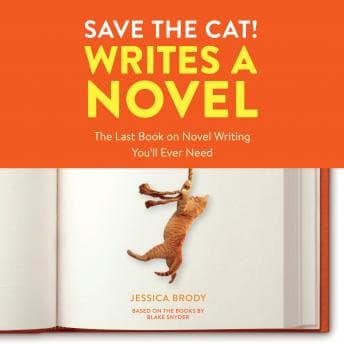

I'll be honest - I almost skipped this one. I've spent twenty years teaching story structure through the lens of Aristotle, Freytag, and Campbell, and the idea of a screenwriting formula being repackaged for novelists made me instinctively bristle. It felt like someone telling me Shakespeare could be reduced to a flowchart. But Denise and I were doing a long Saturday walk along the lakefront, the kind where you loop past Montrose Harbor twice because neither of you wants to go home and grade anything, and I figured I'd give it a fair shot.
I'm glad I did. Sort of.
The Beat Sheet vs. The Beat of Prose
So here's the thing about Jessica Brody's approach: she takes Blake Snyder's 15-beat structure from the screenwriting world - Opening Image, Theme Stated, Catalyst, Fun and Games, All Is Lost, and so on - and maps it onto novels with genuine enthusiasm and a surprising amount of literary credibility. Where I expected her to lean exclusively on commercial thrillers and YA (her own wheelhouse), she actually pulls from a decent range. She breaks down The Hunger Games alongside Pride and Prejudice, and while my inner lit snob wanted to scoff, her beat-by-beat analysis of Austen is... pretty solid? She identifies Elizabeth Bennet's "Shard of Glass" - that internal flaw the protagonist carries - as her pride-driven prejudice against Darcy, and traces how it functions at each structural turning point. It's not a reading that would get you published in a journal, but it's cleaner than half the thesis papers I've graded.
The Ten Story Genres she outlines - Monster in the House, Whydunit, Rites of Passage, and so on - are genuinely useful taxonomies. Not because they're revolutionary (this reminds me of what Hemingway said about all stories being the same story), but because she gives you a vocabulary for diagnosing why your draft isn't working. "Your second act sags because you're writing a Dude with a Problem but you've structured it like an Institutionalized." That kind of specificity is rare in writing guides.
But here's where it gets complicated for someone like me who believes the prose deserves to be savored: Brody's framework is almost entirely mechanical. She'll tell you where the Midpoint should fall (roughly the 50% mark) and what it should do (raise the stakes, shift from fun to serious), but she has almost nothing to say about voice, sentence-level craft, or the kind of lyrical risk-taking that separates a competent novel from one that haunts you. If you loved Beloved or The Sound and the Fury, this book has zero interest in what makes those novels extraordinary beyond their plot architecture. It's a skeleton manual. Beautiful bones. No muscle, no skin. The structural-but-soulless problem reminded me of something Jeff Hobbs does in reverse in The Short and Tragic Life of Robert Peace — there, the architecture of a life is almost incidental, and it's the texture of a person that makes the whole thing land.
When the Author Reads Her Own Textbook
I was braced for disaster here. Author-narrated nonfiction is a coin flip - you either get someone who knows their material so intimately that the delivery feels like a great lecture, or you get someone reading their own book like they're seeing the words for the first time. Brody lands closer to the former. Her delivery is clear, her pacing is steady, and she sounds like she's genuinely teaching rather than performing. She's not going to make you forget Simon Vance or Juliet Stevenson - this is competent instruction, not performance art. But for a craft book? Competent instruction is exactly what you need.
The production quality is clean and professional. No background hiss, no weird editing jumps. One thing worth noting: the book comes with a PDF of charts, beat sheets, and exercises. If you're listening while walking (guilty) or pretending to pay attention somewhere (also guilty), you're going to miss the visual component entirely. I went back later and pulled up the PDF, and honestly, the beat sheet charts are half the value of the book. The audio alone gives you maybe 70% of the experience.
I'd bump the speed to 1.25x during the genre breakdown chapters. Brody is thorough - sometimes too thorough - in walking through every single beat of every example novel, and at normal speed some of those sections drag. My students would probably listen at 2x. My students are wrong about most things, but on this specific point, I understand the impulse.
Who Needs This (And Who Should Keep Walking)
If you're writing your first novel and you're staring at a messy draft wondering why Act Two feels like quicksand? This book is genuinely useful. It gives you structural language and a diagnostic framework that works. If you're a pantser who's never outlined anything, Brody might convert you - or at least make you understand what the outliners are doing.
But if you're an experienced writer looking for something about the art of the novel - the sentence, the image, the rhythm of language - keep walking. This is an engineering manual, not an aesthetic one. And that's fine. We need both. I just wish she'd acknowledged more openly that the beat sheet is a floor, not a ceiling.
Worth Pausing the Faculty Meeting For?
Almost. It's a smart, practical craft book that does exactly what it promises and nothing more. I respect the honesty of that. Not every book needs to be Middlemarch. (Though every faculty meeting could use a little Middlemarch.)