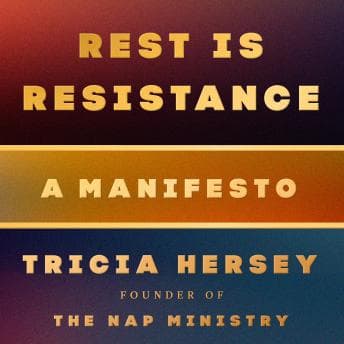

"Brainwashed by capitalism, we subject our bodies and minds to work at an unrealistic, damaging, and machine-level pace."
That line hit me at roughly the 15-minute mark. I was literally running—like, actually sprinting in heels—to catch the 6:14 AM Baby Bullet from San Francisco to Mountain View, clutching a lukewarm latte like it was life support. The irony? It wasn't lost on me. It actually made me stop on the platform and just breathe for a second. (I missed the train. I took the slow one. The world didn't end.)
Debugging My Own Operating System
Look, I usually devour books on optimization. Give me Atomic Habits, give me biographies of founders who sleep four hours a night. My boyfriend Kevin jokes that I treat my sleep schedule like a server maintenance window—minimized for maximum uptime.
But Rest Is Resistance isn't a productivity hack. It's not telling you to nap so you can code better later. That's what tripped me up at first. I kept waiting for the ROI calculation—the "if you rest X amount, your output increases by Y%."
It never comes. And that's the point.
Tricia Hersey isn't offering a patch for the system; she's suggesting we deprecate the whole architecture. She argues that rest is a divine right, not a reward for shipping a feature. For someone whose entire career at a FAANG company is built on "shipping," this was... uncomfortable. It felt like reading a manifesto written by the part of my brain I suppress with caffeine and Jira tickets.
Unlike the typical business books I listen to at 1.75x speed (looking at you, Zero to One), you can't speed-run this. It refuses to be optimized. It's basically the anti-algorithm.
Weirdly, the closest contrast in my commute queue was Scorch Trials (Maze Runner, Book Two), where survival also depends on recognizing when the rules of the system were never built for you.The Nap Bishop's Sermon
Hersey narrates this herself, and honestly, nobody else could've done it. She calls herself the "Nap Bishop," and the narration has this rhythmic, sermon-like quality. It's lyrical. It's warm. It feels like a guided meditation for people who are angry at the system.
That said—and here's where my engineer brain got a little twitchy—it is repetitive.
In software engineering, we have a principle called DRY: Don't Repeat Yourself. Hersey violates this rule constantly. She loops back to "grind culture," "white supremacy," and "capitalism" over and over again. At first, I was annoyed. I was thinking, "Okay, I got the message, let's move to the next function."
But about halfway through, I realized the repetition is a feature, not a bug. It's deprogramming. When you've been told your whole life that your value equals your output, hearing it once isn't enough to overwrite the code. You need the loop. You need the constant reinforcement. Her voice becomes this mesmerizing chant that slowly wears down your defenses.
Who Needs This Permission Slip (And Who'll Hate It)
If you're burning the candle at both ends and using a blowtorch on the middle—give this a listen. But if you're looking for a structured "how-to" guide with bullet points and action items, you're going to be frustrated. It's a vibe. It's a philosophy. It's a permission slip. Skip it if you need frameworks and takeaways; lean in if you need someone to tell you it's okay to stop.
Logging Off
I didn't finish this in my usual two days. I took a week. I actually fell asleep listening to Chapter 4 on the train home (sorry to the guy I drooled on). And for the first time in my life, I didn't rewind to see what I missed. I just let it be.
Do yourself a favor: turn the playback speed down to 1.0x. The code will still be there when you wake up.