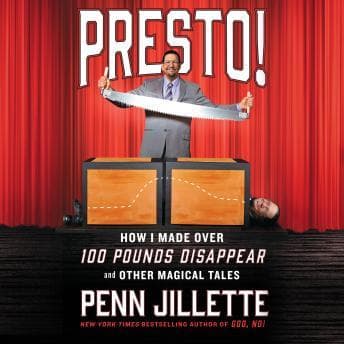

Look, I need to get something off my chest: I'm tired of diet books. Seriously. Every startup founder I work with has a stack of them - Keto this, intermittent fasting that, biohacking whatever. Most of them are 200 pages of pseudo-science wrapped in a TED talk voice. So when Penn Jillette drops a book about losing 100 pounds by eating nothing but potatoes for two weeks, I was ready to hate-listen to this thing.
I didn't hate it. I'm actually kind of mad about that.
The Business Case for Crazy
Here's what got me: Penn approaches weight loss the same way my parents approached their dry cleaning business. No shortcuts, no magic pills, just brutal honesty about what needs to happen. The guy was 330 pounds with blood pressure that would make a cardiologist weep, and he decided to fix it by going full-crazy with a NASA scientist named Ray Cronise. The potato thing sounds insane - and Penn admits it's insane - but the underlying logic is weirdly sound. Strip everything down, reset your relationship with food, rebuild from scratch.
This is basically a business turnaround story disguised as a diet book. Penn treats his body like a failing company: identify the core problem (he was eating like garbage), implement radical change (potatoes, then a whole-food plant-based diet), measure obsessively, iterate. My consulting brain appreciated the framework even when my stomach was screaming "this man ate nothing but potatoes for fourteen days."
Penn Being Penn - For Better and Worse
The narration is Penn. If you've ever seen Penn & Teller, you know exactly what you're getting: loud, profane, opinionated, and somehow charming through all of it. He reads his own book, which means you get the full Penn experience - tangents about atheism, Vegas stories, celebrity name-drops, and way more information about his bodily functions than I needed during my morning commute.
(Jenny asked why I was laughing at 7 AM. I couldn't explain that Penn Jillette was describing his relationship with vegetables in terms I can't repeat here.)
The strength is also the weakness. Penn doesn't edit himself. He'll spend twenty minutes on a genuinely insightful point about how we lie to ourselves about food, then pivot into a ten-minute riff about something tangentially related. At 2.0x speed, I was still checking how much time was left in certain chapters. The 9.5 hours could've been 6 with tighter editing.
But when Penn lands a point, he really lands it. His bit about how we treat food addiction differently than other addictions? That's the kind of insight that sticks. He talks about being fat in Vegas, performing twice a night, and how the shame of it never motivated change - only fear of death did. That's real. 12 Rules for Life hammers this same point home - Peterson's whole framework is built on confronting hard truths instead of comfortable lies. That's what my parents understood instinctively: you don't change until the cost of staying the same becomes unbearable.
Skip It If You Want Meal Plans
This isn't a diet book. If you want calorie counts and shopping lists, look elsewhere. This is a memoir about a loudmouth magician who decided not to die, with weight loss as the vehicle for that story.
It works best for people who are tired of the wellness industrial complex. Penn's skepticism toward conventional diet wisdom is refreshing - he questions everything, demands evidence, and isn't afraid to call BS on the stuff that doesn't hold up. As someone who's watched too many founders fall for whatever health trend is hot on Twitter, I appreciated the rigor underneath the profanity.
Fair warning: there's a lot of profanity, frank talk about bodies and sex, and Penn's aggressive atheism shows up regularly. If any of that bothers you, this isn't your book. He doesn't soften anything for anyone.
The ROI on 9.5 Hours
The core insight is worth the listen. The other 3-4 hours of Penn riffing? Depends on how much you like Penn. I found myself genuinely engaged for about 70% of it, which is better than most business books I've reviewed.
Would I recommend it to clients? Maybe. Not for the diet advice specifically, but for the mindset. Penn's approach to radical change - commit fully, don't half-ass it, measure everything, accept that it's going to suck before it gets better - that's applicable to any transformation, business or personal.
My parents would've liked Penn. They wouldn't have agreed with half of what he says, but they'd respect the work ethic. And in the end, that's what this book is really about: doing the hard thing because the alternative is worse.