
"Cattle die, kinsmen die, you yourself will also die. But the word about you will never die, if you win a good reputation."
That's from the Hávamál — Odin's wisdom poem — and I was standing on the lakefront path near Montrose Harbor when Crawford read it, and I just... stopped walking. Denise kept going for about ten steps before she noticed. There's something about hearing a line that's roughly eight hundred years old land with the clarity of advice your grandfather might give you at the kitchen table. The prose deserves to be savored. This one demands it.
When Your Translator Is Also Your Professor Is Also Your Narrator
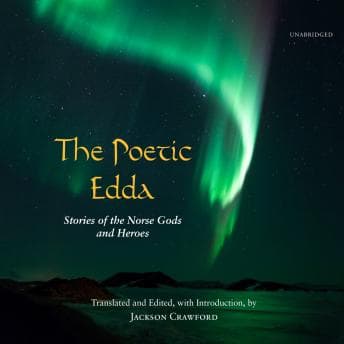
Here's what makes this audiobook a rare thing: Jackson Crawford isn't just reading someone else's translation. He did the translation. He holds the PhD in Scandinavian Studies. He taught this material at UCLA and Berkeley. And now he's sitting in a recording booth pronouncing "Þjóðrekr" and "Sigurðr" like a man who's been saying these names his entire adult life — because he has.
This matters enormously. When Crawford encounters an Old Norse name, there's no hesitation, no anglicized approximation that makes scholars wince. The pronunciation flows naturally into the English around it, which does something subtle but important: it keeps you grounded in the fact that these are poems from a specific culture, a specific time, a specific language. You're not getting a sanitized, Marvel-ified version of Norse mythology. You're getting the weird, bloody, contradictory source material.
And let me be honest — Crawford's delivery is not theatrical. He's not doing separate voices for Odin and Thor and Loki. This is a scholar reading poetry with authority and clarity, not an actor performing a drama. The narrator understands that pause is punctuation. His pacing through the verse structures gives you room to actually hear the rhythm of the original stanzas even in translation. But if you're coming here expecting a full-cast production with sound effects and thunder rumbling behind Thor's hammer — wrong door.
The Gods Are Stranger Than You Remember
Let me talk about what the author is really saying — or rather, what these anonymous poets were really saying a thousand years ago. Because here's what surprised me, even after teaching mythology units for two decades: the Norse gods are not heroic in the way we've been trained to expect. They're petty. They're doomed. They know they're doomed. Odin spends half his poems gathering wisdom precisely because he knows Ragnarök is coming and he can't stop it. There's a fatalism running through these poems that hits different in audio — you can't skim past it the way you might on a page.
The Völuspá (the prophecy of the seeress) is genuinely eerie in Crawford's reading. The world's creation and destruction delivered in this calm, measured voice, almost matter-of-fact. Ice and fire. Gods who build and gods who fail. Everything ends. And then maybe it begins again. My students would hate this. I love it.
The heroic poems in the second half — the Sigurd cycle especially — are harder going. These are fragments. Characters appear and disappear. Motivations are buried in cultural context that Crawford's headnotes try to supply (and mostly succeed at supplying). But at six and a half hours, the whole collection moves at a pace that keeps you engaged without rushing. I listened across four days of paper grading — yes, at 1.0x, because the author chose those words — and found myself rewinding sections of the Lokasenna (Loki's flyting, basically a mythological roast battle) just because Crawford's dry delivery of Loki's insults to every god in Asgard was genuinely funny.
Oh — and there's a "Cowboy Hávamál" appendix where Crawford attempts a southern accent to reframe Odin's wisdom as frontier advice. It's... charming? Unexpected? Worth pausing the faculty meeting for, at minimum. It's the kind of thing that reveals Crawford as someone who genuinely enjoys this material rather than treating it as museum glass.
Who This Is Actually For (And Who Should Probably Skip It)
If you loved reading the Iliad or Beowulf and wished someone would hand you the Norse equivalent with a guide who actually knows what he's talking about — this is it. If you're a mythology enthusiast tired of retellings and want the primary source, Crawford's translation is accessible without being dumbed down. This is why we still read the classics.
But. If you want narrative fiction with a plot that builds and characters who develop across chapters — that's not what the Poetic Edda is. These are poems. Some are connected, some aren't. Some are brilliant, some are fragmentary. Crawford can't fix what the medieval manuscript left broken. Go in knowing that and you'll be fine. Though I'll say — I had a similar reckoning with expectations when I reviewed View From Saturday, where the structure resists the kind of narrative momentum most readers arrive expecting, and the payoff only comes if you meet the book on its own terms.
The Annotation I'd Leave in the Margin
Forty-seven podcast listeners and my wife Denise now know I spent a week muttering about Völuspá stanzas during dinner. The Poetic Edda isn't easy listening. But Crawford's combination of scholarly precision and genuine love for these texts makes this the version I'll be recommending to students, to fellow teachers, to anyone who wants to understand where so much of Western fantasy literature actually comes from. The source code, read by the guy who cracked it.









