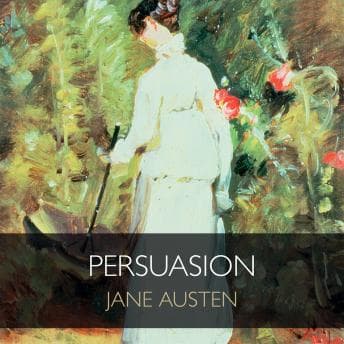

What if the most devastating love story in English literature isn't about passion at all — but about the quiet, excruciating patience of waiting for someone to come back to you?
I was walking the lakefront with Denise last Saturday, early enough that the joggers hadn't taken over yet, and Greta Scacchi was reading me the scene where Anne Elliot watches Captain Wentworth remove a toddler from her back — this small, almost nothing gesture — and I had to stop walking. Just stood there by the water like an idiot. Because Scacchi reads that moment with this weight, this awareness that Anne is cataloging every interaction, every accidental touch, every shift in Wentworth's attention, and she's dying inside. And Scacchi knows it. The narrator understands that pause is punctuation.
The Novel That Austen Wrote When She Was Done Being Polite
Let's talk about what Austen is really saying in Persuasion, because it's not what she's saying in Pride and Prejudice. There's no sparkling banter here, no Darcy striding across a misty field. This is Austen at 41, probably already sick, writing about a woman who made the "sensible" choice eight years ago and has been paying for it every single day since. Anne is 27 — practically ancient by Regency standards — and she's fading. Her family treats her like furniture. Her father literally cannot stop looking in mirrors long enough to notice she exists.
And here's the thing my students would never believe: this quiet, interior, deeply restrained novel about a woman who barely speaks above a whisper for the first three hours? It wrecked me harder than any thriller I've listened to this year. My students would hate this. I love it. The only other book that's caught me off guard like that recently was Heartburn — completely different setting, completely different century, but Ephron writes about love gone wrong with the same kind of devastation dressed up as composure.
At eight hours and ten minutes, it's a perfect weekend listen. Not too long, not rushed. Austen's sentences — those layered, ironic, twenty-clause constructions — need room to breathe, and Scacchi gives them exactly that. Sometimes too much room, honestly. But I'll get to that.
Scacchi's Austen Is a Slow Blade
Greta Scacchi reads with this polished English diction that feels like it was designed in a laboratory specifically for Austen. She doesn't do theatrical voices — you won't get a booming Captain Wentworth or a squeaky Mary Musgrove. What she does instead is shift her sympathies. When she's reading Anne's internal observations, there's this warmth, this ache underneath the composure. When she shifts to Sir Walter's vanity or Mrs. Clay's scheming, the tone cools. It's subtle work. Interpretive work.
And the letter. You know the letter. "You pierce my soul. I am half agony, half hope." I've read that letter a hundred times — assigned it, analyzed it, discussed it in class until the words should've lost all meaning. But Scacchi reads it and I caught something I'd missed: she doesn't rush to the famous lines. She builds through Wentworth's practical sentences first, the ones about arrangements and travel plans, and you can hear the emotion bleeding through his attempts at formality before he just — breaks. The prose deserves to be savored, and Scacchi savors it.
Now. The pauses. Some listeners find them irritating, and I get it. There are moments — particularly in the Bath chapters — where Scacchi holds silence a beat longer than feels natural. If you're a 1.5x or 2x listener, this will drive you up the wall. I listen at 1.0x because the author chose those words, and at that speed, most of the pauses feel intentional. Most. There were a few during Lady Russell's scenes where I genuinely checked if my phone had frozen.
Who Gets an Invitation to This Concert
If you loved Sense and Sensibility for Elinor's quiet suffering, this is its spiritual successor — but sharper, sadder, and more honest about what it costs women to be "sensible." This is for the listener who wants to sit with a book, not race through it. Focused listening, evening walks, a rainy Sunday with nowhere to be.
If you need plot momentum, action, or distinct character voices that announce themselves like different instruments in an orchestra — this isn't your Austen. Try the Rosamund Pike Pride and Prejudice instead. No shame in it.
But if you want to hear what Austen sounds like when she stops performing wit and starts telling the truth about regret? Scacchi is the right guide. One listener said her reading "clued me in to a barb I'd missed in my reading," and that's exactly right. Several of Austen's sharpest observations — the ones buried in subordinate clauses, disguised as polite narration — land differently when Scacchi tilts them with just a fraction more edge.
Worth Pausing the Faculty Meeting For
This is why we still read the classics. Persuasion is Austen's most human novel, and Scacchi treats it that way — not as a museum piece, but as something that still has a pulse. The AudioFile Earphones Award is well-earned. The pauses are a legitimate complaint for some, but for me, they mostly worked. A woman who waited eight years to be loved again probably deserves a narrator who isn't in a hurry.
Denise asked me why I stopped walking that morning. I told her Anne Elliot got her heart broken by good advice. She said, "Again?" She knows me too well.