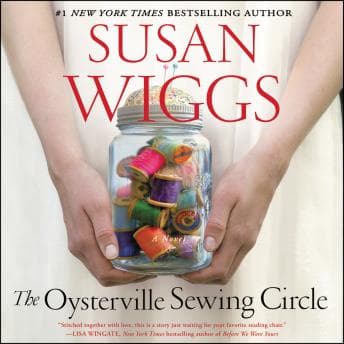

Okay, I need to rant about something first: Susan Wiggs, why are you going to build this gorgeous, emotionally devastating premise — orphaned kids in a backseat, a woman fleeing New York in ruins, a sewing circle that becomes a lifeline for abuse survivors — and then wrap it up like you ran out of thread? I was sitting on my kitchen floor at 1 AM, Diego curled against my thigh, Frida perched on the counter judging my snack choices, and I was SO ready for this book to gut me. And it did. In parts. But then it... didn't? And that's the thing that's been buzzing in my brain since the last chapter faded out.
Let me back up.
The Smoky Voice That Carried the Whole Damn Thing
Khristine Hvam. I hadn't listened to her before this, and now I need to go find her entire catalog because her voice is — okay, imagine whiskey poured over gravel, but gentle? She's got this low, smoky quality that made Caroline feel like a real woman hauling real grief behind her, not a character reciting lines. When she shifts to the kids — Addie and Flick — her register goes lighter, almost breathless with the kind of cautious joy that orphaned children carry. That contrast wrecked me. There's this quality in how she handles the abuse-related scenes that I want to talk about specifically: she doesn't melodramatize them. She goes quiet. She lets the words sit in the silence. That restraint? That's the mark of a narrator who trusts the material enough not to push it. I ugly-cried twice during those sections, both times because Hvam pulled back when a lesser narrator would've leaned in.
But here's where I give credit where it's absurdly due — she elevated material that sometimes didn't earn her performance. More on that in a second.
Caroline Came Home and So Did I
The Pacific Northwest small-town-return setup is practically its own genre at this point, but Wiggs does something I appreciated: Oysterville feels specific. The seafood restaurant, the aging parents hoping their kids will take over, the sewing shop run by Mrs. Lindy Bloom — it's textured. And Caroline's backstory as a fashion designer who clawed her way through Manhattan only to crash and burn? This book felt like watching someone strip off armor piece by piece, standing raw in a town that remembers them before they had any armor at all.
The sewing circle itself — where women gather and slowly reveal their hidden abuse — that's where the book's heart lives. Wiggs doesn't flinch from the domestic violence. She writes it with a directness that made me put down my stylus more than once (I was trying to finish a branding project while listening, and yeah, that didn't work). The content warnings are real: spousal abuse, sexual abuse, emotional abuse. This is not a cozy beach read despite the coastal setting. Abuela would have loved this one — she always said the best novelas were the ones that told the truth about what happened behind closed doors.
Where the Stitching Comes Undone
So here's my frustration. The emotional foundation is solid. The themes are urgent and real. But the plot mechanics — particularly in the back half — feel rushed and a little too neat. The romance with Will Jensen, the childhood-best-friend-turned-Navy-SEAL? The chemistry is... warm? But not chef's kiss. It's more like a pleasant hum than a fire. And the "unexpected challenge" the description teases lands with less impact than the buildup deserves. I kept waiting for that fourth-act gut punch that would send me into full sobbing-on-the-floor mode, and instead I got something closer to a firm nod.
The book is nearly 13 hours, and there are stretches in the middle — around hours 6 through 8 — where the pacing loosens in a way that felt like treading water. Not bad, exactly, but not urgent either. For a book tackling domestic violence, I wanted that tension to stay taut.
Who This Is For (and Who Should Keep Scrolling)
If you love women's fiction that tackles hard subjects inside a small-town framework — think Kristin Hannah territory but a half-step lighter — you'll find a lot to connect with here. I had a similar experience with Lost Girl — women's fiction that leans hard into grief and survival inside a framework that looks warmer than it actually is. If you're coming for a romance-first experience, temper your expectations. The love story is secondary to Caroline's arc and the sewing circle's mission. And if Khristine Hvam's smoky delivery sounds like your thing, honestly, she alone makes this worth the listen.
But if you need your emotional payoffs to match the emotional setup? If anticlimactic endings make you want to throw your phone? You might finish this one feeling like you got 80% of a really good cry.
I got two solid crying sessions out of it. Not my personal record, not even close. But those two hit hard enough that I'm still thinking about them three days later while Frida kneads my lap and I redesign a logo for the fourth time.
The Stitch That Holds
This is a rainy Sunday book — imperfect, warm, heavier than it first appears. Hvam's narration is the thread holding it all together, and she does that beautifully. I just wish the story trusted its own darkness enough to stay in it longer. My heart wanted more. MY HEART.