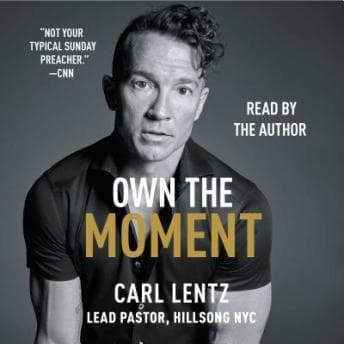

What happens when the person writing the self-help book is also the one reading it to you—and he actually sounds like he believes every word?
I started this on a Tuesday morning, 6:47 AM, packed Caltrain car, running on four hours of sleep after debugging a memory leak until 2 AM. Not exactly prime spiritual awakening conditions. But Carl Lentz has this thing—this casual, almost conspiratorial way of talking—like he's leaning across a coffee table telling you about the wildest thing that happened to him last week. Except the wildest thing is baptizing Justin Bieber in an NBA player's bathtub. (He doesn't name-drop directly, but come on. We all know.)
The 7-Eleven Pitch and Why It Works
The book opens with Lentz as a nobody, literally trying to convince a night shift clerk at a Virginia Beach 7-Eleven to come to his church service. There's something disarming about that image—this guy who now fills rock venues in Manhattan, once standing under fluorescent lights next to the Slurpee machine, making his case to someone who probably just wanted to finish their shift.
That's the Lentz formula: relatable origin story + big dreams + practical faith application. It's basically startup culture but for your soul. That same ROI mindset shows up in Millionaire Next Door, though applied to actual money instead of spiritual growth. And honestly? The ROI on this audiobook is decent if you're in the right headspace for it.
He's good at avoiding what he calls "church words"—that insider Christian vocabulary that makes non-religious people's eyes glaze over. His Bible readings feel more like "here's an ancient text that's surprisingly relevant to your Tuesday" than sermon. I appreciated that. As someone who grew up going to church but drifted away in college, I found his approach... accessible? Not condescending.
When the Energy Drops
Here's where I have to be honest: the back third of this book lost me.
Around hour five, somewhere between San Mateo and Palo Alto, I realized I'd been zoning out. The chapters started feeling repetitive—same structure, same energy, diminishing returns. It's like when a startup pitch deck has twelve slides that could've been six. The core message is solid, but it gets diluted.
Lentz narrating his own work is a double-edged sword. On one hand, you get genuine passion—the man clearly believes what he's saying, and that authenticity comes through. On the other hand, there's no professional narrator pacing, no strategic pauses, no vocal variety to keep you locked in during the weaker sections. He's got one gear: earnest and energetic. Works great for 4-5 hours. Less great for 7+.
At 1.5x speed, this became much more manageable. I'd recommend that for anyone whose attention wanders.
The Instagram Era Problem (Actually Addressed Well)
One thing Lentz nails: the tension between faith and our obsession with curated perfection. He talks about embracing your flaws in a world that rewards filters and highlight reels. This isn't groundbreaking—every self-help book published after 2015 touches on this—but he grounds it in specific personal failures rather than abstract platitudes. Give and Take does something similar with vulnerability in professional settings, showing how admitting weakness can actually be strategic.
He admits to moments of doubt, to parenting struggles, to times when his faith felt performative. That vulnerability is what separates this from the typical "I figured it out, let me tell you how" genre. He's debugging his own life in real-time, which—as someone who debugs systems for a living—I respect.
Who Gets Value Here (And Who Should Skip)
Perfect for: Anyone curious about faith but allergic to traditional church culture. People in transition—new job, new city, new relationship—looking for grounding. Listeners who want inspiration without the prosperity gospel nonsense.
Skip if: You want rigorous theological depth. If you're already deeply embedded in a faith tradition, this might feel surface-level. Also skip if you need a polished, professional narrator—this is raw author energy, for better or worse.
Worth a Credit? My Caltrain Verdict
I finished this in about 5 commutes at 1.5x. It's not going to change your life (despite what the marketing copy promises), but it might shift your perspective on a few things. Lentz is genuinely likable, his stories are entertaining, and his core message—stop waiting for perfect conditions, own the moment you're in—is solid advice whether you're religious or not.
The production is bare bones. No music, no effects, just Lentz talking. That works for the intimate, conversational vibe he's going for. But it also means there's nothing to carry you through the slower sections.
Worth a credit? Probably not at full price. But if you catch it on sale or have a spare credit burning a hole in your account, it's a decent listen for the morning commute. Just maybe not the 2 AM insomnia sessions—you need something with more narrative drive for those.