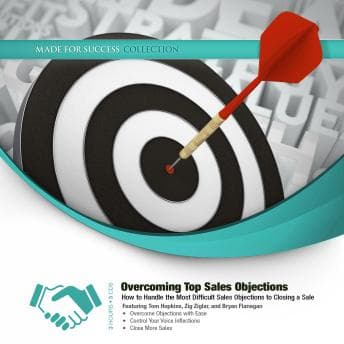

"The prospect doesn't care about your product. They care about their problem."
That's Bryan Flanagan somewhere around the 45-minute mark, and I actually paused my morning coffee to write it down. Which is rare. Most sales audiobooks get the 2.0x treatment and a mental eye-roll. This one earned my full attention—at least for the first half.
What IBM and Xerox Actually Taught Their Closers
Bottom line: This is 3 hours and 14 minutes of concentrated sales wisdom from people who've actually closed deals, not theorists who've read about closing deals. Flanagan's four-step objection-handling framework is the real deal—I've seen variations of it work at three different companies I've consulted for. The needs-based approach isn't revolutionary in 2024, but hearing it broken down by someone who started as an IBM delivery boy and worked his way up? That's credibility you can't fake.
The structure is smart. You get Flanagan's systematic methodology, then Zig Ziglar drops in with his voice inflection techniques for the five most common objections. And look—Zig Ziglar in 2024 might feel dated to some, but the man understood human psychology at a gut level. That same instinctive understanding of what motivates people shows up in Best of Les Brown Audio Collection, though Brown leans harder into the emotional fuel than the tactical mechanics. Ziglar's section on adjusting your vocal tone when a prospect says "I need to think about it" versus "The price is too high"—that's not theory. That's decades of actual selling distilled into actionable technique.
Tom Hopkins rounds it out with pricing psychology. How to find out what people will actually pay versus what they say they'll pay. Classic Hopkins material, still relevant.
The Multi-Narrator Gamble
Here's where I have to be honest. Three narrators—Flanagan, Ziglar, Hopkins—means three different energy levels, three different recording qualities, three different eras of sales philosophy. Flanagan is lively, fast-paced, clearly passionate about his material. The man sounds like he'd sell ice to Eskimos and make them thank him for it. Ziglar brings that legendary motivational warmth. Hopkins is... Hopkins. Professional, competent, maybe a touch more formal.
The transitions between speakers can feel like switching radio stations. Not jarring enough to ruin the experience, but noticeable. If you're expecting a smooth single-voice narrative, recalibrate. This is more like a sales conference in your earbuds—different speakers taking the stage.
The Efficiency Question
At 3 hours and 14 minutes, this respects your time. Finally, a business book that doesn't pad 45 minutes of insight into 8 hours of anecdotes about the author's morning routine. I listened at normal speed—unusual for me—because the information density actually justified it. Minimal fluff. Flanagan in particular moves through material like someone billing by the hour.
That said, not everything lands equally. Some role-play scenarios feel dated. The examples occasionally assume a sales environment that existed before LinkedIn and cold email became the primary prospecting tools. You'll need to mentally translate some concepts to modern contexts. But the underlying psychology? Timeless. My parents didn't have a "four-step objection framework" when customers complained about dry cleaning prices. They had instinct. Same instinct, now with a TED talk.
Who Gets Value, Who Doesn't
This is for salespeople who've hit a plateau. You know your product, you can get meetings, but you're losing deals at the objection stage. If that's you, skip to the Flanagan sections on the "feel, felt, found" technique—it's chapter 2-ish, and it's worth the entire credit.
Not for you if: You're looking for cutting-edge digital sales tactics, social selling strategies, or anything involving automation. This is old-school, human-to-human selling. Also not for you if you need entertainment with your education—this is utilitarian, not charming.
Jenny would say I'm being harsh about the dated examples. Jenny is right. But she also doesn't sit through three pitch decks a week from founders who can't handle the "we need to think about it" objection. I do. And I wish more of them had listened to this first.
The Credit Calculation
Three hours of concentrated technique from people who've actually sold things. Multiple frameworks you can implement tomorrow. Voice inflection training that works for phone and video calls. The multi-narrator format is imperfect but not dealbreaking.
Wait for a sale if you're casually curious. Buy it now if you're actively losing deals to objections you don't know how to handle. The ROI math is simple: close one additional deal because of something you learned here, and the credit pays for itself a hundred times over. Same logic applies to You Need a Budget—one month of actually following the system pays back the investment indefinitely.