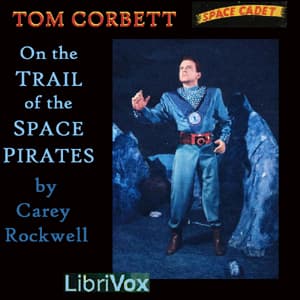

"Stand by to reduce thrust!" — somewhere around the 45-minute mark, and honestly, that could be the tagline for this entire book. Reduce thrust, because we're cruising through 1950s space opera at a pace that doesn't need warp speed. I was up way too late reorganizing my board game shelf (alphabetical? By player count? By weight? The eternal struggle) and needed something light in my ears. On the Trail of the Space Pirates fit that vibe perfectly — pulpy, earnest, and completely unironic about its love of square-jawed cadets saving the solar system.
Golly Gee, There Are Pirates in Space
Let me set expectations: this is a 1950s juvenile sci-fi novel. Carey Rockwell — which is a pen name, because of course it is — wrote these Tom Corbett books to tie into the TV show, radio series, and basically every media format that existed before podcasts. The worldbuilding here isn't Sanderson-level. It's more like... the D&D equivalent of a one-page dungeon. You've got your Space Academy, your Solar Guard, your rocket cruiser named Polaris, and a gang of space pirates who are described with the kind of menace usually reserved for Saturday morning cartoon villains. The pirates are "hard-boiled professional murderers" according to the summary, but in practice they feel about as threatening as a goblin encounter at level 5.
And you know what? That's fine. That's actually the charm. Tom Corbett and his crew — Astro the big Venusian and Roger Manning the wise-cracking one — fall into archetypes so clean you could use them as pre-gen characters. The progression isn't satisfying in the way I usually mean that (no stat blocks, sadly), but there's a satisfying formula: the boys get in over their heads, they rely on their training, they pull through. It's comfort food. Space-flavored comfort food with a side of Cold War optimism about what humans could do if we just pointed our rockets at the stars instead of each other. That uncomplicated faith in humanity actually reminded me of the early sections of Morning Star before everything goes sideways — there's something genuinely affecting about stories that believe people can be straightforwardly good.
LibriVox Did the Thing (And It Mostly Works)
So here's where it gets interesting. This is a LibriVox dramatic reading — multiple volunteer narrators each voicing different characters. And look, I need to be honest: LibriVox recordings are free. They are made by passionate volunteers donating their time. You are not getting Steven Pacey here. Steven Pacey walked so other narrators could run, and LibriVox volunteers are... enthusiastically walking. Sometimes at different speeds.
The multi-reader format actually suits this book surprisingly well. Having distinct people read distinct characters means you get automatic voice differentiation, which is something a lot of solo narrators struggle with even when they're getting paid. Each volunteer is assigned specific characters from a cast list, so Tom sounds different from Roger sounds different from the pirate captain. That said, the production quality varies reader to reader — some are clearly recording in treated spaces with decent mics, and others sound like they're in a room with tile floors and a ceiling fan. The volume levels shift between chapters. There's no music, no sound effects. It's bare bones.
But here's my take: for a pulpy 1950s space adventure that's under 6 hours? The format works. It gives the whole thing a radio drama feel, which is appropriate given that Tom Corbett literally WAS a radio drama. It's almost like historical recreation. My D&D group would love this — it's basically what our sessions sound like, different people voicing different characters with wildly inconsistent audio quality because Dave refuses to use push-to-talk.
Who Should Strap Into the Polaris
If you're looking for hard sci-fi with rigorous orbital mechanics and morally gray characters, walk away. This isn't for you. But if you grew up on pulp adventure, if you have any love for the Golden Age of sci-fi, or if you just want something light and earnest while you're doing chores or sorting your Wingspan cards by habitat — this scratches an itch. It's also great for kids. Like, actually great for kids. The values are simple, the heroes are brave and kind, nobody gets graphically murdered. I read this instead of writing my thesis, and I regret nothing. (I should regret something. Dr. Patel, if you're reading this, I was definitely working on my procedural generation chapter.)
The 5-hour-44-minute runtime is easy to knock out in a couple of sessions. At 1.25x speed, the pacing feels more natural — some of the volunteers read a touch slow, and bumping it up gives the action scenes a little more zip.
The Final Hyperspace Jump
On the Trail of the Space Pirates is a time capsule. It's not going to blow your mind. It's going to make you smile, maybe roll your eyes at the earnestness, and remind you that there was a time when space cadets were heroes and pirates were villains and nobody needed to deconstruct that. For a free LibriVox listen, it delivers exactly what it promises. Just don't expect Sanderson. Expect Saturday morning serials with rocket ships and heart.