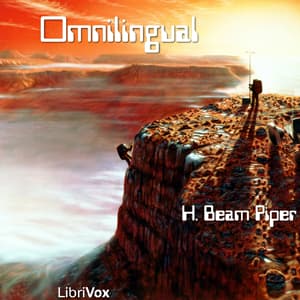

I was up at 4:30 AM last Tuesday - not because of an on-call page for once, but because Kevin's alarm went off and he just... didn't hear it. (How does someone sleep through that? How?) Anyway, I was wide awake, coffee in hand, with about two hours to kill before my train. So I fired up this little under-two-hour classic and finished the whole thing before I even left the apartment.
Here's the thing about Omnilingual: it's basically a linguistics puzzle box dressed up as 1950s Mars exploration. And honestly? For a story written in 1957, the core premise - how do you decode a dead alien language without a bilingual text - holds up way better than most golden age SF I've listened to.
The Rosetta Stone Problem, But Make It Martian
TL;DR: Worth your commute, but it IS your entire commute and then some change.
The setup is deceptively simple. Human expedition finds a preserved Martian university (yes, university - not just ruins, an actual academic building with classrooms and a library). They've got shelves of Martian books and zero way to read them. Martha Dane, the linguist on the team, is convinced she can crack the language. Everyone else thinks she's wasting expedition resources.
What I genuinely appreciated - and this is where Piper's reputation for writing strong female characters in the 1950s actually shows up - is that Martha isn't written as a token. She's the smartest person in the room and the story knows it. The men around her aren't cartoonish villains either; they're scientists with legitimate skepticism about whether a dead language with no living speakers CAN be decoded. The tension isn't manufactured drama, it's an actual epistemological disagreement. When was the last time you heard that in a short story?
The solution Martha arrives at - I won't spoil it, but it involves a specific universal constant that any technological civilization would organize knowledge around - is genuinely clever. Like, I-paused-the-audiobook-and-thought-about-it clever. It's the kind of idea that makes you go "oh, obviously" after the reveal, which is the hallmark of a good puzzle.
Mark Nelson Does the Heavy Lifting
At under two hours, this is basically a novella, and the narration has to carry a LOT of dialogue between scientists arguing about methodology. Mark Nelson handles this with solid timing - he's got a measured, deliberate pace that fits the academic tone without dragging. His intonation shifts cleanly between Martha's frustrated determination and the dismissive skepticism of characters like Lattimer, who's basically that one senior engineer on your team who shoots down every idea in code review.
Nelson isn't Ray Porter (need I say more about that man), but he's a genuinely pleasant narrator. The listener quote I saw - that his narration made the tale "bearable" - is honestly selling him short. He elevates what could've been a dry archaeological procedural into something you actually want to follow. No wild vocal gymnastics, no accents, just clean delivery with the right emotional beats in the right places.
Where the Dust Settles Thin
Okay, real talk. This is a 1957 short story. The characters beyond Martha are pretty flat. The Mars expedition feels more like a campus field trip than a dangerous planetary mission - there's zero environmental tension, no survival stakes, just people in rooms arguing about books. If you're coming to this expecting The Martian or even Rendezvous with Rama, recalibrate hard.
The pacing in the middle third is... patient. Piper spends a lot of time on expedition politics and academic turf wars that feel realistic but aren't exactly pulse-pounding. At 1.5x it was fine. At 1.0x I think I would've drifted.
And the gender dynamics, while progressive for 1957, still have that golden age residue. Martha has to fight twice as hard to be heard, which is accurate to... well, to now, honestly, but the story doesn't quite interrogate it the way a modern author would. It just presents it.
Perfect For: Your Shortest Commute Day
The ROI on this audiobook is actually pretty solid - it's free on LibriVox, it's under two hours, and you walk away with a genuinely interesting idea about universal language decoding that'll rattle around your brain during standup. It's the kind of story that would make an excellent blog post (affectionately, this time) if it weren't already a story.
Perfect for: a short commute, a lunch break, killing time before a deploy. Skip for: anything where you need sustained world-building or deep character work. This is a puzzle story. It gives you the puzzle, it gives you the answer, and it exits clean.
If you've burned through Project Hail Mary and The Bobiverse and you're looking for the intellectual ancestor of "scientist solves impossible problem through clever reasoning," this is it. Though fair warning - not every SF read scratches that same itch; Life as We Knew It is in the same genre neighborhood but leans hard into emotional survival stakes over puzzle-solving, which is worth knowing before you queue it up. Sixty-seven years old and the central idea still slaps.