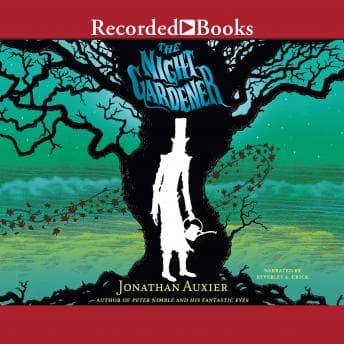

Look, I wasn't expecting to get genuinely creeped out by a middle-grade book. But here I am, a grown man who plays D&D in dimly lit basements, getting the shivers from a Victorian ghost story about two Irish orphans and a creepy tree.
Jonathan Auxier's The Night Gardener hit me like a really well-designed one-shot campaign—tight, atmospheric, and with that moral weight that makes you think about it days later. I listened to this instead of working on my thesis (shocking, I know), and honestly? No regrets.
The Sanderson Comparison You Didn't Ask For
Okay, hear me out. This isn't epic fantasy. There are no magic systems with hard rules or cosmere-spanning implications. But Auxier does something Sanderson also does brilliantly: he builds his supernatural elements with consistency. The Night Gardener—this spectral figure tending to a massive, wrong-feeling tree—operates by rules. The wishes, the dreams, the slow corruption of the family living in the manor. It all clicks together like a puzzle box.
The Windsor family is basically what would happen if you threw a cautionary tale about greed into a haunted house and let it simmer for a century. Each family member is trapped by their own desires, and watching Molly and Kip (our protagonist siblings) figure out the pattern is genuinely satisfying. My D&D group would love this—it's got that investigative horror vibe where the kids are piecing together lore while trying not to become part of it.
And the tree. THE TREE. It's giving me major Mirkwood energy, but more personal. More insidious. The way it grows through the house, the way its roots seem to reach for you... Auxier's descriptions are chef's kiss.
Beverley Crick Behind the Mic
So here's where I gotta be honest—I couldn't find a ton about Beverley A. Crick online beyond this audiobook. But based on what I heard over these nearly nine hours? She's solid.
Her Molly is fierce and protective in exactly the right ways. Kip—Molly's younger brother with a limp and a talent for storytelling—comes through as genuinely endearing without being annoying. The sibling dynamic here actually reminded me of the community bonds in Murder in an Irish Village—different genres entirely, but both nail that Irish resilience thing. (That's harder than it sounds. Annoying kid characters in audiobooks are my personal nemesis.) And Hester, the old woman who knows more than she's letting on? Crick gives her this wily, knowing quality that made me sit up and pay attention every time she appeared.
The Irish accents for the siblings feel genuine, and the snobbish English family members are appropriately insufferable. The pacing is steady—not theatrical, not over-the-top, just clear and committed.
BUT. And this is a real but. Some folks found the narration a bit too subdued. One listener literally said it wasn't captivating enough to distract from traffic. I get it. If you're coming from something like Steven Pacey's First Law narration (where every character is a distinct theatrical performance), Crick might feel restrained by comparison. She's not trying to be a one-woman show. She's telling you a story by the fire.
For me? It worked. The story is creepy enough that I didn't need the narrator to amp it up. But if you need high-energy performance to stay engaged, maybe sample first.
Roll for Initiative (Or Don't)
This is perfect for parents looking for something genuinely spooky but age-appropriate to share with kids, fans of gothic atmosphere and moral fables, anyone who loved Coraline or The House With a Clock in Its Walls, and commuters who want atmospheric dread without gore.
Skip if you need theatrical narration to stay hooked, you're impatient with slow-burn horror, or Victorian settings just aren't your thing.
The content warnings are mild—some violence, themes of abandonment and poverty, standard ghost story stuff. Nothing that would give a ten-year-old nightmares. (Okay, maybe a few nightmares. The good kind.)
Stories All the Way Down
One thing that really got me: this book is partly about storytelling. Kip tells stories to cope, to survive, to make sense of the world. And the book itself functions as a story-within-a-story-within-a-story at points. Auxier clearly loves the craft, and it shows.
There's a line somewhere about how the best stories are the ones that change you. And yeah, that's a bit on the nose, but it earned it. The ending doesn't pull punches, but it's not grimdark either. It's hopeful in a way that feels true.
At 8 hours and 51 minutes, this is a perfect weekend listen. I burned through it across a Saturday of "working on my thesis" (read: avoiding my thesis) and a Sunday morning of pretending to organize my bookshelf.
Pack It Up, Adventurers
Would I listen again? Probably not immediately—it's not that kind of book. But I'd absolutely recommend it to anyone looking for a smart, spooky, surprisingly moving story. The kind of thing that reminds you why you fell in love with fantasy in the first place.
Now if you'll excuse me, I need to go check that the tree outside my apartment window isn't growing any closer to the building.