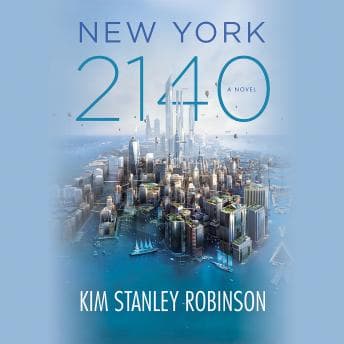

So last Tuesday I was stuck in an Uber from SFO because Caltrain decided to have a mechanical issue at Millbrae - classic - and I had about 90 minutes of Kim Stanley Robinson's drowned Manhattan to keep me company. Twenty-two and a half hours of audiobook. That's roughly two weeks of commutes. And honestly? I have complicated feelings about how I spent those two weeks.
Nine Narrators Walk Into a Flooded Skyscraper
TL;DR: Worth your commute, but only if you're okay with KSR occasionally stopping the plot to deliver a graduate seminar on financial instruments.
Let me break down the technical setup first because it matters. Nine narrators. Nine. That's not a full-cast production - it's closer to a relay race where each runner has a very different stride. Each narrator handles a different POV character: the finance bro, the building super, the two feral kids kayaking through submerged streets, the cop, the internet-famous airship pilot, and a few others. The first 3-4 hours? Genuinely confusing. You're trying to map voices to characters to storylines, and your 6AM brain is not equipped for this level of context-switching. It's like reading a codebase with nine different coding styles and no documentation.
But here's the thing - once the mapping clicks (somewhere around hour 5 for me), the ensemble actually works. Peter Ganim's chapters as the building manager have this weary, steady competence that anchors the whole thing. Robin Miles brings real warmth to Inspector Gen. Jay Snyder does the finance guy with just enough smarm that you're not sure if you're supposed to like him. The weakness? When two narrators occasionally voice the same secondary character in different chapters and the voice doesn't match. It's like a merge conflict that nobody resolved.
KSR Wrote a 600-Page Love Letter to Lower Manhattan (and to Keynesian Economics)
The world-building is the star. Full stop. Robinson imagines a New York where fifty feet of sea level rise turned everything below the old waterline into a Venice-style "SuperVenice" - buildings connected by skybridges, people commuting by vaporetto, and the real estate market somehow still being absolutely unhinged. The specificity is wild: he knows which buildings would survive based on their actual foundations, which neighborhoods would become intertidal zones, and how the Met would adapt. If you're someone who's ever stared at a flood map of Manhattan and thought "but what would the zoning look like," this is your book.
The problem - and this is where it lost me during several commutes - is that Robinson can't resist the economics lecture. There are entire chapters that are basically interstitial essays about the history of finance, the 2008 crash, moral hazard, and how capital markets could theoretically be restructured after a climate catastrophe. These chapters have their own narrator (Robert Blumenfeld, doing a kind of omniscient historian voice) and they read like... well, like they could've been a blog post. Several blog posts. A whole Substack, really. At 1.5x they're tolerable. At normal speed I would've lost my mind somewhere around the third explanation of credit default swaps.
The Characters Are Load-Bearing Walls (Some Are Stronger Than Others)
The two kids - Stefan and Roberto - exploring the drowned ruins below the waterline are genuinely great. There's this sense of adventure mixed with real danger that reminded me of a cli-fi Huckleberry Finn. Angles of Attack scratched a similar itch for me - that same texture of people just trying to survive inside systems much larger than themselves, with enough technical specificity to feel real. The coders who disappear from the rooftop feel like people I actually know - their subplot about discovering something valuable in the flooded depths has real thriller energy.
But some characters feel more like functions than people. The finance trader exists primarily to explain how markets work. The lawyer exists to explain how law works. They're mouthpieces first and humans second, and a few of them - I won't say which because opinions vary wildly on this - felt like they were written to represent an archetype rather than to be someone specific. Kevin actually tried this book after I told him about it and DNF'd at hour 8 because he said it felt like "a municipal planning meeting with occasional plot."
He's not entirely wrong. But he's also not entirely right.
Should You Burn 22 Hours on This?
Perfect for: long commutes, road trips where you want to feel smarter by arrival. Skip for: gym sessions (too slow), bedtime (you'll lose the thread), anything requiring less than full attention.
The ROI on this audiobook is high if you're into climate fiction, urban planning nerdery, or you loved Robinson's Mars trilogy and want to see him tackle Earth. The nine-narrator setup is ambitious and mostly succeeds - I'd call it a 3.5 out of 5 on narration because the ensemble is strong individually but the coordination has rough edges. The book itself is a slow burn that's brilliant when it trusts its characters and exhausting when it trusts its economics lectures.
I finished this in about 12 commutes. Would I do it again? Probably not. Am I glad I did it? Yeah, actually. The image of a flooded, adapted, still-hustling New York stuck with me longer than most sci-fi I've consumed this year. That's worth something.
Speed recommendation: 1.5x minimum. 1.75x for the interstitial economics chapters. Your sanity will thank you.