
"A story is a character who wants something and overcomes conflict to get it."
That line hit me around hour two, somewhere between Redwood City and Palo Alto, and I actually paused the book to think about it. Which is saying something, because at 6:47 AM I'm usually operating on pure autopilot and caffeine fumes.
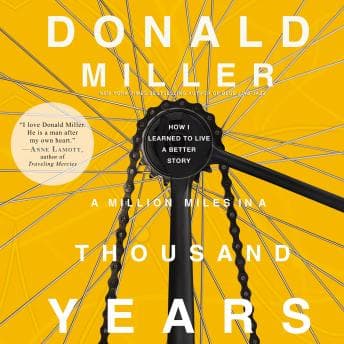
Here's the thing about Donald Miller's A Million Miles in a Thousand Years: it's basically a debugging session for your entire life. And I mean that as the highest compliment. Miller takes this deceptively simple framework—story structure—and applies it to the messy, meandering thing we call existence. The inciting incident that forces you off the couch. The conflict that makes you interesting. The resolution that actually means something.
When Your Memoir Gets a Rewrite
The setup is almost too perfect. Two movie producers approach Miller about adapting his bestselling memoir Blue Like Jazz into a film. But here's the problem: Miller's actual life at that point? Kind of boring. He's successful on paper but sleeping until noon, avoiding relationships, generally coasting. The producers start fictionalizing his story to make it compelling, and Miller has this brutal realization—if his real life needs Hollywood writers to make it interesting, maybe he's living wrong.
What I love is that Miller doesn't just philosophize about this. He actually does something. He bikes across America. He reconnects with his estranged father. He starts a nonprofit helping kids in difficult circumstances. He stops treating his romantic life like a series of daydreams and actually pursues someone. The kayaking trip where he meets Bob Goff—this larger-than-life character who becomes a kind of mentor figure—is the moment where the book shifts from introspection to action.
Author-Narrated, and It Actually Works
Miller narrates this himself, and normally I'd dock points for that. Authors reading their own work is hit-or-miss at best. But here it's the right call. His delivery is conversational, almost like he's telling you this story over coffee (or, in my case, over the rhythmic clacking of Caltrain wheels). There's a self-deprecating humor that comes through—the way he admits to being a mess, the way he laughs at his own pretensions. You can't fake that energy with a professional narrator.
The pacing is solid too. At 5 hours 11 minutes, this is basically a three-commute book. No padding, no bloat. Miller knows when to let a metaphor breathe and when to move on. I finished it faster than I expected, which is the mark of something that actually holds your attention.
The God Question (For Those Who Care)
Okay, so this is shelved under Religion & Spirituality, and yeah, there's a Christian framework here. Miller's asking questions like "Why hasn't God fixed us yet?" and finding answers in narrative structure. If that's not your thing, you might bounce off some sections.
But here's my take as someone who doesn't usually reach for faith-based self-help: the story principles are universal. You don't need to believe in a divine Author to recognize that your life has an inciting incident, rising action, and (hopefully) a meaningful resolution. The framework holds up even if you strip out the theological layer. I've read plenty of secular productivity books with less practical insight than this.
Who Should Queue This Up (And Who Should Skip)
Perfect for: anyone stuck in a rut, anyone who's optimized their career but neglected their actual life story, anyone who needs a kick to stop spectating and start participating. Also genuinely good for long drives or focused listening—this isn't background noise material.
Skip if: you need hard data and actionable frameworks. This is memoir-as-philosophy, not a step-by-step guide. Also skip if you're allergic to any mention of faith, though honestly, it's lighter on the preaching than you'd expect.
The ROI Calculation
The return on this audiobook is surprisingly high for something this short. Miller's central insight—that we're all living stories, and we have more editorial control than we think—stuck with me past the commute. I caught myself thinking about my own "inciting incidents" while debugging a particularly gnarly race condition the next day. (The race condition did not care about narrative structure, but still.)
Is it life-changing? That depends on whether you actually do something with it. Miller's whole point is that a good story requires action, not just understanding. The book is the invitation. You have to RSVP.
I finished this in 3 commutes, and I'd recommend it to anyone who's ever felt like their life is a first draft that needs editing. Which, let's be honest, is most of us.
Though if you want that same story-structure tension delivered through pure narrative momentum rather than memoir, I found the conflict engine in Dust & Decay surprisingly compelling—sometimes it helps to see "character wants something, overcomes conflict" working at full throttle in fiction before you apply it back to your own life.