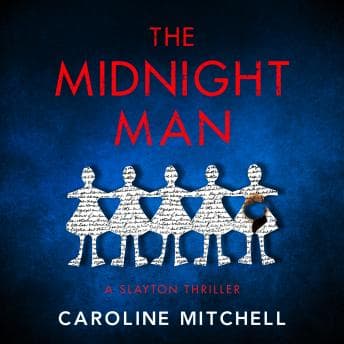

I was shelving returns in the horror section at the library — yes, my branch actually has a decent horror section because I've spent years curating it — when I remembered I still had three hours left on this one. So I popped my earbuds in and finished it between the stacks, surrounded by King and Koontz and Jackson, which felt appropriate because The Midnight Man is trying very hard to sit on that shelf. Whether it earns its spot? That's complicated.
The Prologue Sets a Check the Book Can't Quite Cash
"I remember the day I died quite clearly." That opening line? Genuinely good. The kind of hook that makes you pause what you're doing and lean in. The whole prologue — five teenage girls breaking into Blackhall Manor to play the Midnight Game, only four coming home — is the setup for something that could've been devastating. Caroline Mitchell clearly knows how to build a doorway into dread. The problem is what's behind it.
Once we shift into the investigation with Detective Sarah Noble, the book settles into a much more conventional rhythm. Sarah's connection to Blackhall Manor gives the story personal stakes, and seven-year-old Elliott Carter — a kid seeing things in his dreams that no child should — adds a genuinely unsettling layer. Mitchell's background as a former police detective shows in the procedural beats. They feel grounded, real, lived-in. But the supernatural elements and the police work sometimes feel like they're in two different books fighting for the same spine.
And the red herrings. Look, I appreciate misdirection — it's the bread and butter of mystery writing. But there's a point where you've scattered so many false leads that the reader stops trusting the narrative entirely. I hit that wall around hour six. When everything's suspicious, nothing is. The tension Mitchell builds in those early chapters gets diluted by the constant pivots, and by the time we reach the reveal, the impact is softer than it should be.
Two Narrators, One Atmosphere That Actually Works
Here's where things get interesting. Elliot Fitzpatrick and Emma Gregory handle dual narration, and their performances are what kept me locked in through the slower stretches. Gregory carries Sarah's chapters with a controlled intensity — she doesn't oversell the fear, which is exactly right for a detective trying to hold it together while her past comes crashing back. Fitzpatrick brings something different: when he voices the Midnight Man, there's this low, deliberate quality that made me genuinely uncomfortable shelving books alone in a quiet library. The narrator commits. That's rare.
The two performers complement each other without competing, which is harder to pull off than it sounds with dual narration. Neither one breaks character to do "the voice" — you know what I mean, that thing where narrators suddenly shift into cartoon villain mode for the antagonist. The Midnight Man stays human-shaped and wrong, which is always scarier than going full monster.
That said, I wouldn't call either performance exceptional enough to elevate the material beyond its limitations. They're solid. Professional. They understand the assignment. But there weren't moments where I rewound just to hear a line again, which is my personal benchmark for narrator magic.
Shirley Jackson Walked, and Mitchell Is... Jogging
Someone compared this to early Stephen King, and I can see it — the small-town setting, the psychic child, the house with a history. But King's early work succeeded because the mundane horror (alcoholism, poverty, domestic violence) was inseparable from the supernatural horror. Here, Mitchell touches on trauma and PTSD, and Sarah's backstory has real weight, but the book doesn't fully commit to letting the darkness breathe. It pulls back when it should push forward.
The haunted house premise — Blackhall Manor as a location with accumulated evil — is solid genre territory. I had a similar itch reading Paris Rose — that sense of a dark setting that keeps you at arm's length when you're desperate for it to pull you under. But I kept waiting for the house itself to become a character the way Hill House does, the way the Overlook does. It stays a setting. A creepy one, sure. But just a backdrop.
What Mitchell does well is pace the investigative thread. The book moves. Nine and a half hours didn't feel padded, and the chapter breaks hit at the right moments to keep you pressing play. For a first-in-series entry, it does the work of establishing Sarah Noble as someone worth following.
Who Needs This in Their Ears
If you're a mystery-first listener who likes a paranormal garnish — someone who reads Cara Hunter or C.J. Tudor and wants that police procedural backbone with something darker lurking underneath — this will work for you. It's a solid autumn listen. (Someone called it "pumpkin spice mystery" and honestly? Yeah. That tracks.)
If you scare easily, skip. If you don't — and you're coming to this expecting pure horror — temper your expectations. This understands that horror isn't about gore, it's about dread, but it doesn't always trust itself enough to stay in that dread. It keeps retreating to safer procedural ground.
My podcast listeners are going to have opinions about this one. I can already hear the emails.
Shelved Under: Promising But Holding Back
I wanted this to be scarier than it was. The bones are there — the house, the game, the child who sees too much, the detective haunted by her own history. Mitchell has the instincts. The narrators have the skill. But the execution stays at a simmer when it needed to boil. I'll check out book two because I think this series could grow into something sharper. But this first entry? It's the appetizer, not the meal.
Shirley (my cat) was unimpressed. I was... intrigued. Not terrified. There's a difference.