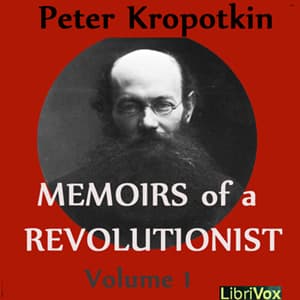

I wasn't expecting to spend seven and a half hours listening to a 19th-century Russian prince explain why he gave up everything to become an anarchist. But here we are. And honestly? This might be the most unexpectedly relevant business book I've listened to this year. (Yes, I'm calling it a business book. Fight me.)
Bottom line: Kropotkin's memoir is a crash course in organizational dysfunction, class dynamics, and why top-down systems fail. The fact that he figured this out in Tsarist Russia while I watched the same patterns destroy three different startups? That's either depressing or validating. Maybe both.
When a Prince Sounds Like Your Immigrant Parents
Here's what got me. Kropotkin was born into Russian nobility—we're talking serfs, estates, the whole deal. But the way he describes watching the system grind people down, the inefficiency of it all, the way those at the top had zero understanding of how things actually worked on the ground... I've seen this exact dynamic at every Fortune 500 company I've consulted for.
He talks about his military education, the bureaucracy, the pointless hierarchies. And I'm sitting there on my morning run thinking about my parents' dry cleaning business in Koreatown. They had no formal training. No MBA. No "leadership development programs." But they understood something Kropotkin figured out the hard way: the people doing the work know more than the people giving orders. This is what my parents did instinctively. Now it has a TED talk.
The Siberia chapters are where it really clicked for me. Kropotkin gets sent to the frontier, sees how communities actually organize themselves when the central government can't reach them, and starts questioning everything he was taught. It's basically a 19th-century case study in decentralized operations. I've pitched this exact concept to founders who looked at me like I was insane.
Elin's Steady Hand on Dense Material
Elin has this calm, measured delivery that works well for memoir material. Clear, easy to follow, good pacing. She doesn't try to do dramatic Russian accents or anything gimmicky—which is the right call here. This is a book of ideas, not a novel with characters to differentiate.
That said, Jenny would say I'm being harsh, but there are stretches where the delivery gets a bit... flat. Kropotkin's writing can be dense, and when you're deep into his observations about Russian peasant communes or geological surveys, a narrator who stays in one gear can make it harder to stay locked in. I found myself drifting during some of the longer descriptive passages. My 2.0x speed couldn't save this one entirely—I actually dropped to 1.5x for the more complex sections, which is rare for me.
But here's the thing: the content is so good that I pushed through. And Elin's consistency actually helps when Kropotkin gets into his more philosophical moments. You're not distracted by performance choices. You're just... thinking.
The ROI Calculation
If you want quick, actionable business tactics, skip this. There's no "7 habits" framework here. No worksheets. Kropotkin isn't trying to sell you a consulting package.
But if you're interested in understanding WHY organizations fail, why people resist authority, why the most efficient systems are often the ones that emerge organically from the ground up—this is essential listening. I've read dozens of books on organizational design. Most of them are recycling ideas this guy articulated 130 years ago. Benjamin Franklin: Made in America covers similar ground—another self-made thinker who questioned authority and built systems from the ground up.
Fair warning: the other 7 hours aren't all gold. There are sections on his childhood and education that feel more like historical context than insight. Skip to the Siberia chapters if you're pressed for time. That's where the real value is.
I'm genuinely curious about Volume 2 now. Kropotkin's story doesn't end in Siberia—he goes on to become one of the most influential thinkers of his era. But this first volume lays the groundwork. It shows you how someone raised in a system of total control came to reject it completely.
What My Parents Already Knew
My parents never read Kropotkin. They didn't need to. They lived the same realization every day—that the people at the top rarely understand what's happening at the bottom, and that real work gets done despite the system, not because of it.
Worth the listen if you're willing to work for it. Just don't expect it to hold your hand.







![Steve Jobs [unabridged audiobook] audiobook cover](/_next/image?url=https%3A%2F%2Fcovers.audiobooks.com%2Fimages%2Fcovers%2Ffull%2F9788499923406.jpg&w=1920&q=75)