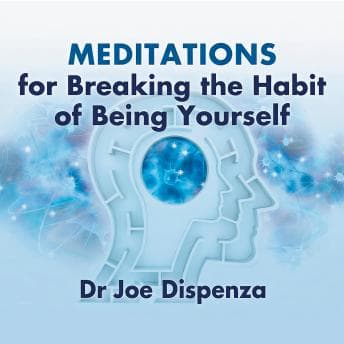

"Become no body, no one, no thing, no where, in no time."
That's Dr. Joe Dispenza's mantra, repeated throughout these guided meditations. I was listening at 11 PM after a particularly brutal client call—startup founder convinced his burn rate was "strategic"—and honestly, becoming no one sounded pretty appealing.
Here's the thing. I've read Dispenza's main book. My wife Jenny bought it for me after I had three consecutive nights of 4-hour sleep during a restructuring project. The book has some interesting neuroscience concepts buried under a lot of quantum physics hand-waving. These meditations? They're the practical companion piece. And at 2 hours 29 minutes, they respect your time more than 90% of business audiobooks I've suffered through.
The ROI Calculation on Inner Peace
Bottom line: This is a meditation program, not an audiobook. If you're expecting narrative or information delivery, you're in the wrong aisle. It's designed to move you from Beta brain waves (your analytical, stressed-out state) to Alpha (that floaty pre-sleep zone where your subconscious is supposedly more accessible).
The structure is a four-week progressive program. Week one focuses on body awareness—placing attention on different parts of your body "in space." Week two expands to the space around your body. Sounds woo-woo, I know. My parents would have called this "expensive sitting still" and gone back to folding shirts.
But here's what I noticed: after three sessions, I was falling asleep faster. Not during the meditation—though that happened too—but at actual bedtime. For a guy who mentally rehearses client presentations at 2 AM, that's worth something.
The Synthesizer Problem Nobody Warned Me About
Dispenza narrates this himself, which makes sense—it's his methodology. His voice is calm, authoritative, the kind of voice that makes you believe he definitely has a PhD (he's actually a chiropractor, but let's not get into credentials). The pacing is intentionally slow. Meditative. This is not a 2.0x speed situation. I tried. It sounds like a panicked robot having a spiritual experience.
But here's the issue that genuinely irritated me: there are voice synthesizer effects layered over his narration in certain sections. Some kind of reverb or echo treatment that's supposed to feel transcendent but actually pulled me out of the meditation every single time. It's like someone in post-production said "this needs more ethereal" and cranked a dial they shouldn't have touched.
One reviewer called these meditations "the longest 20 minutes of my life." I get it. When you're expecting a quick relaxation exercise and you're 40 minutes into body scanning your left ankle "in space," time becomes elastic in an uncomfortable way.
The Pseudoscience Elephant
Let's address this directly because the reviews are polarized: a significant chunk of listeners dismiss this as pure pseudoscience. The mixing of neuroscience terminology with quantum physics concepts is... loose. Dispenza talks about "coherent brain-wave patterns" and "operating systems of your subconscious" in ways that would make an actual neuroscientist twitch.
My take? I've seen worse reasoning in McKinsey decks that cost clients $500K. At least this one's trying to help you sleep better.
The meditation techniques themselves—body scanning, breath awareness, visualization—are legitimate practices with actual research behind them. The theoretical framework Dispenza wraps around them is where things get sketchy. If you can separate the practice from the philosophy, there's value here. If the "quantum field" language makes you want to throw your phone, skip this entirely.
Who Gets Value, Who Gets Frustrated
This works for you if: you've read the main book and want guided practice, you're meditation-curious but need someone talking you through it, or you're a Type-A personality (guilty) who needs permission to sit still.
Skip this if: you want information delivered efficiently, you have zero patience for New Age framing, or you're expecting traditional audiobook value. Also skip if you're already an experienced meditator—this is remedial level stuff dressed up in fancy language.
Jenny would say I'm being harsh. Jenny is right. But she'd also agree that $15 for what amounts to a meditation app with one voice and some questionable audio effects is a tough sell when Headspace exists. Then again, The Midnight Library taught me that sometimes the most transformative experiences come from unexpected sources—even if they're wrapped in packaging that makes you skeptical at first.
Net-Net on the Woo-Woo
At 2.5 hours, this is a tool, not entertainment. The production choices are questionable. The science is debatable. But the core practice—learning to quiet the analytical mind that's running scenarios at 3 AM—that has legitimate applications.
I've used Week 1 meditation six times now. Not because I'm converted to the Church of Dispenza, but because it works as a shutdown ritual after high-stress days. That's a narrow use case, but it's an honest one.
If you're buying this expecting transformation, you'll be disappointed. If you're buying it as a specific tool for a specific problem—learning to meditate with guidance—it delivers. Just maybe wait for a sale. And for the love of efficiency, don't try to speed it up.