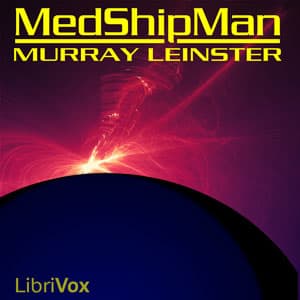

Look, I'm going to be honest - I went into Med Ship Man expecting something like a D&D one-shot: quick, self-contained, maybe a little janky, but fun. And that's... pretty much what I got? But also not? Let me explain why I'm slightly annoyed.
A Planet Full of Nobody and a Space Doctor Who Won't Shut Up
Murray Leinster wrote this in the golden age of sci-fi, and it feels like it. Calhoun is your classic competent-man protagonist - he's a Med Service officer who rolls up to the planet Maya for a routine check-in and finds it completely empty. No people. No signals. Just... nothing. And instead of doing the reasonable thing (turning around, filing a report, going home), he decides to investigate. Because of course he does. He's basically a space paladin with a medical kit instead of a holy symbol.
The real star here is Murgatroyd, his tormal - a little alien creature who basically exists to be adorable and medically useful. Think of him as the familiar in a wizard's party, except his special ability is literally biological. He processes diseases and produces antibodies. That's his whole deal. My D&D group would love this concept for a homebrew companion creature, honestly. Murgatroyd doesn't get a ton of dialogue beyond variations of "Chee!" but he's the emotional anchor of the story in a way that surprised me for something this short.
The mystery itself unfolds at a pace that feels both rushed and padded - a weird trick for something that's only 96 minutes long. Leinster dumps a LOT of exposition about how interplanetary medical services work, how colony worlds develop, the political structures involved. If you don't like info-dumps, this isn't for you (but you're wrong). I genuinely enjoyed the world-building around the Med Service concept. It's Sanderson-level thinking applied to public health infrastructure in space. The idea that plagues could be weaponized for colonial land grabs? That's dark. That's interesting. That's the kind of premise that deserves a full novel, not a novella. The political intrigue layered into what looks like a simple medical mystery reminded me of how Super Sad True Love Story buries genuinely unsettling systemic critique inside what initially reads as a personal story - both books use a small-scale protagonist to expose something ugly about how power actually moves.
Mark Nelson and the Case of the Missing Tension
Here's where I have to split with some of the other listeners. Mark Nelson's narration is... fine? It's pleasant. He reads clearly. He's got a LibriVox-quality delivery that works for what this is - a free audiobook of a 1960s novella. But some folks have pointed out that his cadence during the suspenseful passages reads more like someone narrating a product demo than a man alone on a dead planet. And yeah, I can hear it. There's a flatness when Calhoun discovers the empty cities that should hit harder. The moments where tension should ratchet up just... don't.
Steven Pacey walked so other narrators could run, and Nelson is kind of standing still here. He's not bad - I want to be clear about that. But when Calhoun is piecing together what happened to Maya's population, there should be an edge to the delivery. Some urgency. Instead it stays at one temperature the whole way through. For a 96-minute listen, that's not a dealbreaker, but it does mean the climactic revelations land with a thud instead of a punch.
(I was listening to this while supposedly outlining Chapter 3 of my thesis on procedural terrain generation. I outlined exactly zero paragraphs. Dr. Patel would not be surprised.)
Vintage Sci-Fi Comfort Food, Served Lukewarm
Here's the thing about Med Ship Man - it's a curiosity piece. It's a window into what sci-fi readers in the early '60s thought space medicine and colonialism might look like. The science is hand-wavy in that charming retro way where nobody questions why a single doctor is the entire medical infrastructure for an interstellar government. The progression is satisfying in a puzzle-box way: clue leads to clue leads to revelation. But it wraps up SO fast once the mystery breaks open that I felt cheated out of actual consequences.
If you're a classic sci-fi completionist, or if you've got 96 minutes to kill and want something that won't demand too much of you, this scratches an itch. It's cozy space adventure with a medical thriller coating. But don't go in expecting the depth that premise deserves.
Who should grab this: Fans of Asimov's lighter work, people who enjoy procedural problem-solving in sci-fi, anyone who wants to try Leinster without committing to a full novel. Who should skip: If you need your narrators to match the energy of the scene, or if you want character development beyond "competent man is competent," this will frustrate you.
I Read This Instead of Writing My Thesis (Again)
It's free on LibriVox. It's 96 minutes. It introduced me to a cool concept (space medical service! biological familiar creatures!) wrapped in a mystery that needed about twice the runtime to actually breathe. I don't regret listening. I also don't think I'll remember it next month. But Murgatroyd? Murgatroyd I'll remember. Chee.