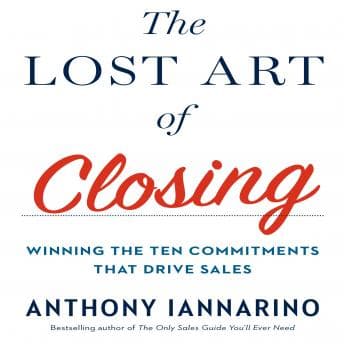

Everyone keeps saying sales books are dead, that modern buyers don't want to be "closed," that if you just provide enough value the deal will magically happen. And honestly? After years of listening to engineering managers fumble through quarterly planning like it's a hostage negotiation, I was curious whether a sales book could actually teach me something about getting commitments from humans. I grabbed this one on a Monday morning, half-caffeinated, wedged between a guy manspreading across two Caltrain seats and someone's overstuffed Patagonia backpack.
TL;DR: Worth your commute if you deal with humans professionally - which, last I checked, is everyone.
Not Your Dad's "Always Be Closing" Playbook
So here's where Iannarino breaks from the pack. Most sales books treat closing like it's this big scary boss fight at the end of a dungeon. You grind through discovery, demos, proposals, and then BAM - you need some secret technique to seal the deal. Iannarino basically says that's backwards. His framework is ten sequential commitments - time, exploration, change, collaboration, building consensus, investing, reviewing, resolving concerns, deciding, executing - and the actual "close" is just the natural last step if you didn't screw up the first nine.
It's basically a state machine for sales conversations. And as someone who debugs distributed systems, I found that weirdly satisfying. Each commitment is a checkpoint. If you can't get commitment #4 (collaboration), you have no business jumping to commitment #8 (resolving concerns). The failure mode isn't at the close - it's upstream, and the system just surfaces it late. That's... literally how I think about production incidents.
The part that actually stuck with me was his argument about the "commitment to change." Before you pitch anything, you need the prospect to acknowledge that their current state isn't working. Not that your product is great - that their status quo is broken. That reframe alone is worth the listen, because I've watched so many internal proposals at work die because the proposer jumped straight to solution without establishing that anyone actually felt the pain.
Author-Narrated: The Good and The Meh
Iannarino narrates this himself, and look - he's not Ray Porter. (Nobody is. That man is a national treasure.) But there's something to be said for hearing a sales framework from the person who actually built it. His delivery is clear, authoritative, a little flat in spots. You can tell he's a speaker, not an actor - he hits the key phrases with practiced emphasis but doesn't really modulate much between sections. It's like listening to a really solid conference keynote for five hours.
At 1.75x, which is my standard for business books, this clipped along at a good pace. Never had to rewind, never lost the thread. The structure is clean enough that even at 6AM brain-fog levels, I could track which commitment we were on and why it mattered.
Here's my honest gripe though: there's repetition. He circles back to the same core thesis - closing is about all the commitments before the close - maybe four or five times more than necessary. I get it, Tony. I got it at hour one. The book is 5 hours and 10 minutes, and I genuinely think you could compress the unique content into about 3.5 hours. Could've been a blog post is too harsh, but could've been a shorter book? Absolutely.
The ROI on This Audiobook Is...
Actually pretty solid if you're in any role that requires buy-in from other people. I'm not in sales. I'm an IC engineer. But I spend a shocking amount of my week trying to get commitments - from product managers who need to sign off on technical decisions, from partner teams who need to prioritize our integration work, from my own manager when I want to propose architectural changes. Iannarino's framework maps surprisingly well to cross-functional work in tech. The commitment to invest (time, resources, political capital) before asking for a decision? That's just good stakeholder management with a sales vocabulary bolted on.
Kevin, who actually does customer-facing work, stole my headphones and listened to the last two hours. His take: "This is what I already do intuitively but now I have language for it." Which is either a compliment or means the book is obvious. Probably both.
Who Should Queue This Up (And Who Shouldn't)
Perfect for: commute, gym, any half-attention listening. The structure is linear and the concepts are sticky enough that you won't lose the plot.
Skip for: anyone who's already read Iannarino's blog extensively - you'll recognize a lot of the thinking. Also skip if you want entertaining narration. This is functional, not fun.
Best audience: early-to-mid career salespeople, founders doing their own selling, and honestly, engineers and PMs who need to get better at internal influence. Worst audience: senior sales leaders who've already developed their own closing methodology - this will feel too introductory.
Ship It, But Maybe Wait for a Sale
At just over 5 hours, this is a two-commute book that punches above its weight conceptually but under-delivers on density. The ten-commitment framework is genuinely useful and I've already caught myself thinking in those terms during a design review last Thursday. The content-versus-packaging tension reminded me of Brand, Meet Story, which has the opposite problem - slicker presentation wrapped around a thinner core idea. But the production is bare-bones, the narration is competent-not-captivating, and the repetition padding is noticeable. Worth your time, probably not worth a full credit when there are meatier business listens out there.