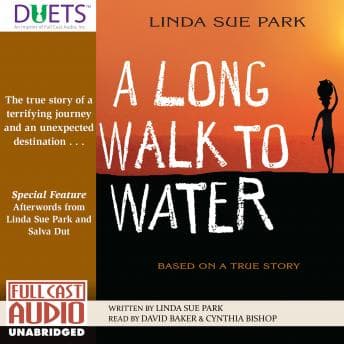

What does it cost to walk eight hours for water? And I don't mean in calories or blisters - I mean what does it cost a childhood?
I picked up A Long Walk to Water because my D&D group's been talking about running a survival-focused campaign, and I wanted something to get me in the headspace of actual hardship. You know, for research. (Yes, I'm aware how that sounds. No, I don't care.) What I got was a gut-punch wrapped in deceptively simple prose that had me sitting in my car in the Georgia Tech parking lot, staring at nothing, for a solid ten minutes after it ended.
This is a short listen - under three hours - but it packs more emotional weight than some 40-hour epics I've tackled. Linda Sue Park tells two stories that run parallel across decades: Salva, an eleven-year-old boy fleeing the Sudanese civil war in 1985, and Nya, a girl in 2008 whose entire life revolves around the daily trek to fetch water for her family. The dual narrative structure works brilliantly here, and honestly? It's the kind of storytelling economy that makes me jealous. Park doesn't waste a single word.
The Voices That Carry This Story
David Baker and Cynthia Bishop split narration duties, and they each bring something completely different to the table. Baker handles Salva's chapters, and his performance is... look, stirring feels like an understatement. There's this unrushed quality to his delivery that lets the horror breathe. He doesn't oversell the trauma - he doesn't need to. When Salva loses people, when he's walking through literal death, Baker's restraint makes it hit harder. The terror is in the quiet moments, not the dramatic ones.
Bishop takes Nya's sections with this meditative, almost hypnotic rhythm that mirrors the endless repetition of the girl's daily walk. Eight hours there. Eight hours back. Every single day. Bishop makes you feel the weight of that monotony without making it boring to listen to - which is a neat trick when you think about it.
Here's the detail that really got me: they brought in James Achueil as a dialect coach. Achueil was one of the actual Lost Boys of Sudan. He made the same journey Salva makes in this book. That's not just attention to authenticity - that's honoring the story in a way that matters. The accents feel genuine because they are genuine, filtered through someone who lived it.
When Two Stories Become One
The way Park weaves these narratives together is the kind of structural elegance I wish I could pull off in my own writing. (Thesis? What thesis?) You spend the whole book wondering how a boy fleeing war in 1985 connects to a girl fetching water in 2008. And when it clicks - when you finally see how these threads tie together - it's not a twist so much as an inevitability. The book earns that moment through everything that came before.
I'll be honest: the pacing is slow by design. This isn't an action-packed thriller. If you need constant plot momentum, this might test your patience. But the slowness is the point. The Nightingale works the same way—quiet devastation that builds until you can't look away. Salva's journey across Sudan isn't exciting - it's exhausting. Nya's daily walk isn't dramatic - it's crushing. The audiobook makes you sit with that reality instead of rushing past it.
For my fellow fantasy nerds: think of it like a survival campaign where the DM isn't pulling punches. No deus ex machina. No convenient rescue. Battle of the Labyrinth has some of that same relentless forward momentum, though admittedly with more monsters and less existential dread. Just one foot in front of the other, day after day, hoping you make it.
Who Should Queue This Up (And Who Should Pass)
Grab this if you want a meaningful listen you can finish in an afternoon. Perfect for educators (the classroom discussion potential is huge), and honestly? It's a solid reality check for those of us who complain about our commutes. My twenty-minute drive to campus suddenly felt pretty trivial. Skip it if you need fast pacing or can't handle depictions of war, death, and the casual cruelty that comes from desperate circumstances.
Roll for Emotional Damage
This is an Audie Award finalist for good reason. The production is clean, the performances are excellent, and the story itself is based on the real Salva Dut, who went on to found Water for South Sudan. That ending - knowing it's real, knowing this kid survived and then went back to help - transforms the whole listening experience.
Is it heavy? Yeah. But it's also hopeful in a way that doesn't feel cheap. Park doesn't sugarcoat the suffering, but she doesn't wallow in it either.
My D&D group is definitely getting a recommendation. And maybe I'll finally get back to my thesis. (Probably not. But maybe.)