
I started this one on a rainy Tuesday afternoon, folding laundry with zero motivation, and within fifteen minutes Mara's story had me standing still next to a pile of unfolded towels, just... listening. That's the thing about Ali Hazelwood's novellas — they grab you fast, because they have to.
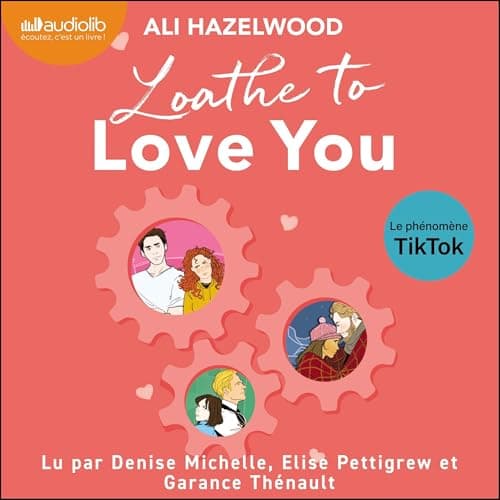
Loathe to Love You collects three STEMinist novellas — Under One Roof, Stuck with You, and Below Zero — into a single audiobook. Three scientist heroines. Three infuriating men. Three forced proximity setups that escalate from hostility to heat with the inevitability of a chemical reaction. Roommates sharing a house, strangers trapped in an elevator, researchers stranded together at NASA's Arctic station. You know where each one is headed. The question is whether the ride there makes you feel something, and honestly? Mostly yes.
What surprised me was how much the three-narrator setup changes the experience. Denise Michelle narrates Mara's story, and there's this edge to her comedic delivery — she'll land a sarcastic line with a half-beat pause that makes you actually laugh out loud, which is harder to pull off in audio than people realize. When Mara is mentally cataloging all the reasons she hates her new roommate while clearly being attracted to him, Michelle's voice does this subtle thing where the irritation thins out just slightly, and you catch the shift before Mara does. That's good narration.
Garance Thénault brings a different texture to Sadie's elevator story — warmer, a little breathless in the claustrophobic moments, which works for a scenario where two people are literally stuck in a small metal box together. The romantic tension there is almost physical in her voice. And then Elise Pettigrew takes over for Below Zero, and this was the novella that worked best for me as a listening experience. The Arctic research station setting already feels isolating on the page, but Pettigrew leans into the quietness of it — her pacing slows when Hannah is alone with her thoughts, and then picks up when the banter starts sparking. There's a scene where the cold outside becomes almost a character, and Pettigrew's delivery made me feel the chill before the warmth between the leads kicked in.
So the narration genuinely adds something here. Three voices for three stories means you never get that audio fatigue that sometimes hits in longer collections. Each narrator resets your ear.
But here's where I started second-guessing my initial enthusiasm. Around the halfway mark of the second novella, I noticed I was predicting dialogue before it happened. Not the exact words, but the shape of every scene — the misunderstanding, the proximity-induced moment, the emotional crack in the love interest's brooding exterior. Hazelwood writes this formula with confidence because she's earned that confidence. She's a #1 New York Times bestselling author with a PhD in neuroscience, and she knows her audience inside and out. But at roughly three hours per story, these romances don't have the runway to surprise you. They execute the beats cleanly and move on.
The characters are fun in the moment and thin in memory. I finished the collection two weeks ago and I can tell you about the Arctic station, the elevator, and the shared house — but I'd struggle to describe what makes Hannah different from Sadie as a person, beyond their scientific specialties. Compare that to Olive from The Love Hypothesis, who stuck with me for months. The novella format just doesn't give these women enough room to become fully dimensional.
I had a similar frustration with Below Zero as a standalone — Hannah is charming in flashes but the compressed runtime keeps her at arm's length.
The bonus chapters from the male POVs are a smart addition. They don't transform anything, but they give you that peek behind the stoic-guy curtain that the tight novella structure can't always accommodate. One moment where a love interest's internal monologue reveals how early he actually fell — that landed emotionally in a way the heroine's POV alone couldn't have delivered.
The French translation by Joëlle Touati sounds natural in the narrators' mouths, though I'd note that this is a translated edition, so francophone listeners weighing their options should know the banter maintains its rhythm well — nothing felt stilted or awkwardly converted from the English.
I kept thinking about what this collection actually is: it's three shots of espresso when sometimes you want to sit with a full cup of coffee. If you're between longer reads, or you want something that delivers warmth and wit without asking for a twenty-hour commitment, these novellas do that job well. The steamy scenes have genuine heat, the STEM settings feel authentic rather than gimmicky, and the humor is sharp enough to earn actual laughs in audio.
Harder You Fall scratches a similar itch — same sharp wit and earned heat, and I'd rate it a notch higher for how much it actually surprised me in the back half.
Who should listen: Hazelwood fans craving a quick fix between her full-length novels, or anyone who wants steamy STEM romance in bite-sized doses with genuinely good narration. Who should skip: If you need real character depth to stay invested, or if you've already read enough Hazelwood to recognize every beat before it arrives, the compressed format will amplify those repetitions instead of hiding them. If you're curious about her style, start with The Love Hypothesis instead — it gives you the same energy with enough space to actually fall in love alongside the characters.